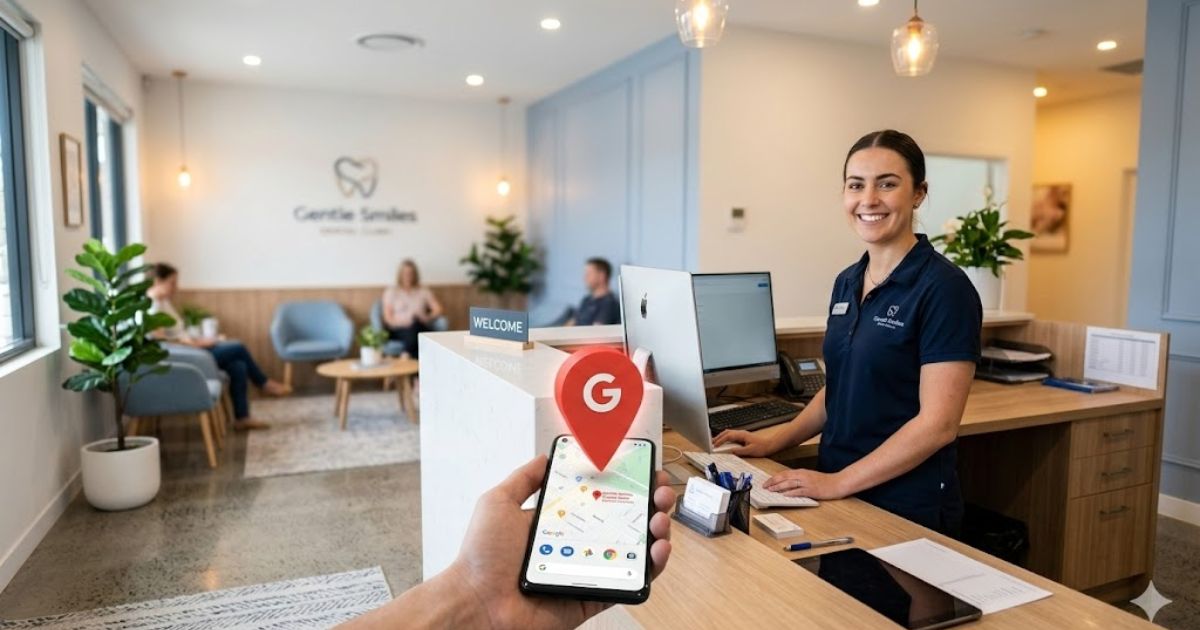

When someone has a toothache at 9pm, they do not ask a friend for a recommendation. They open Google and type ‘dentist near me open now’. When a family moves to a new city, they search ‘best family dentist in [area]’. When someone finally decides to fix their smile, they search ‘dental implants [city]’ or ‘teeth whitening near me’.
Every one of those searches is a patient ready to book. The question is whether they find your clinic or your competitor’s.
That answer is almost entirely determined by your local SEO. Not your website design. Not how long you have been practising. Not even how good your work is. If Google cannot find you, confirm you are trustworthy, and show you to patients in your area, none of those things matter.
This guide covers everything your dental clinic needs to rank in the Google Map Pack, earn patient trust before they even click, and convert searchers into booked appointments. Every strategy here is specific to dental, not generic SEO advice with the word ‘dentist’ dropped in.
New to local SEO entirely? Read our Complete Local SEO Guide for Small Businesses first for the foundational framework. Then come back here for the dental-specific layer on top.
Why Local SEO Is the Highest-ROI Marketing Channel for Dental Clinics
Most dental clinics spend their marketing budget on pamphlets, newspaper ads, or social media. These channels interrupt people who were not thinking about dentistry. Local SEO does the opposite. It puts your clinic in front of people who are actively searching for a dentist right now.
The intent gap between someone who sees your Facebook ad and someone who searches ‘root canal specialist near me’ is enormous. One is being interrupted. The other is already sold on needing the service and just looking for the right provider.
Dentistry is one of the highest local search intent categories that exists. Patients search for specific treatments, specific locations, and specific qualities like ‘painless’, ‘gentle’, ‘experienced’. Every one of those searches is a conversion opportunity. Your job is simply to be visible when they search.
There is also a trust dimension unique to dental that amplifies the importance of local SEO. A patient choosing a dentist is making a health decision, often an anxiety-driven one. They will read your reviews more carefully than a restaurant customer ever would. They will look at your photos, your qualifications, your response to negative reviews. Every part of your online presence contributes to the decision.
Local SEO builds that trust systematically, in every place a potential patient looks.
How Patients Actually Search for a Dentist
Understanding search behaviour is the foundation of everything. Before you optimise anything, you need to know what your potential patients are typing.
Dental searches fall into four categories:
| Search Type | Examples and What It Tells You |
|---|---|
| Emergency searches | ‘Dentist open now’, ’emergency dentist near me’, ‘toothache dentist open today’. Highest urgency, highest intent. These patients will call the first clinic that appears. |
| General searches | ‘Dentist near me’, ‘dental clinic in [city/area]’, ‘family dentist [neighbourhood]’. Patient needs a regular dentist. Comparing options before deciding. |
| Treatment searches | ‘Root canal [city]’, ‘teeth whitening near me’, ‘dental implants [area]’, ‘Invisalign provider near me’, ‘wisdom tooth extraction [city]’. Patient knows what they need and is finding a specialist. |
| Quality and trust searches | ‘Best dentist in [city]’, ‘painless dentist near me’, ‘gentle dentist for nervous patients’, ‘dentist with good reviews [area]’. Patient is anxious or selective and looking for reassurance before booking. |
Each of these four search types needs a different part of your online presence to respond to it. Emergency searches need your hours and phone number to be accurate and visible. Treatment searches need dedicated service pages on your website. Quality searches need your reviews and credentials to be prominent.
Your local SEO strategy needs to cover all four.
Google Business Profile: Your Most Important Asset
Your Google Business Profile is what puts you in the Map Pack, that box of three dental clinics that appears at the top of results when someone searches ‘dentist near me’. Most patients never scroll past the Map Pack. If you are not in those three spots, you are largely invisible for the most common dental searches.
Category Selection for Dental Clinics
This is the most common GBP mistake dental clinics make. Most choose ‘Dentist’ as their primary category. That is correct but often not specific enough. Google has these dental-specific categories available:
- Dentist (general practice)
- Dental Clinic
- Cosmetic Dentist
- Orthodontist
- Oral Surgeon
- Periodontist
- Pediatric Dentist
- Emergency Dental Service
- Endodontist
- Prosthodontist
Your primary category should reflect your most common and most valuable patient type. A practice that does mostly cosmetic work should consider ‘Cosmetic Dentist’ as their primary category. A paediatric specialist should use ‘Pediatric Dentist’. If you are a general practice, use ‘Dentist’ as primary and add the most relevant secondary categories for the treatments you perform most.
The competitor check: Search your top keyword, for example ‘dentist [your city]’, and look at what primary category the top three Map Pack results are using. That tells you what Google currently associates with the strongest signal for that search in your market.
The GBP Fields That Matter Most for Dental Clinics
Beyond the basics, these fields are specifically important for dental practices:
Services: Add every treatment you offer as a separate service with a description. Root canal, dental implants, teeth whitening, Invisalign, veneers, wisdom tooth extraction, children’s dentistry , each one is a keyword. Each description is indexed content.
Attributes: Dental-specific attributes include ‘accepts new patients’, ‘online appointments’, ‘wheelchair accessible’, ‘anxiety-friendly’, ‘NHS dentist’ (UK), ‘accepts insurance’. These appear on your listing and filter searches. If you accept new patients but have not checked that attribute, you are invisible to people filtering for it.
Photos: For dental clinics, the most important photos are your reception and waiting area, your treatment rooms, your team, and before and after results (with patient consent).
Patients want to see a clean, modern, calm environment before they decide to come in. A warm, professional waiting room photo does more for conversions than almost any other element of your listing.
Business description: Include your qualifications, your specialties, the treatments you are known for, and your location. A sentence about your approach to nervous or anxious patients is particularly powerful for dental because anxiety is one of the primary reasons people delay booking.
For the complete GBP optimisation guide with every field and advanced tactics, read our How to Optimise Your Google Business Profile.
Keyword Strategy for Dental Clinics
Dental keyword research is more nuanced than most local businesses because your patients search both by location and by specific treatment. You need to rank for both.
The Two Keyword Types You Need
Location keywords: ‘Dentist in [city]’, ‘dental clinic [neighbourhood]’, ‘best dentist [area]’. These are your broadest local terms. Your homepage and GBP profile target these.
Treatment keywords: ‘Root canal [city]’, ‘teeth whitening near me’, ‘dental implants [city]’, ‘Invisalign [area]’. Each of these needs a dedicated page on your website to rank well. You cannot rank for ‘dental implants [city]’ with a single line on your services page.
The High-Value Treatment Keywords Worth Targeting
| Treatment Keyword | Why It Matters |
|---|---|
| Root canal treatment | High urgency, high fear, patient is in pain and searching right now |
| Dental implants | High value treatment, patient has been considering it for a while |
| Teeth whitening / bleaching | High volume cosmetic search, low anxiety, easy conversion |
| Invisalign / clear aligners | Brand-aware search, patient has already done research |
| Wisdom tooth removal / extraction | High urgency when it becomes painful, high conversion |
| Dental veneers | High value cosmetic treatment, selective patient |
| Pediatric / children’s dentist | Parent searching for a family-friendly practice |
| Emergency dentist / open now | Highest urgency search that exists in dental |
| Nervous patient / dental anxiety | Underserved keyword with very high conversion from anxious patients |
| Dental checkup / scale and polish | Routine care search, good for building long-term patient base |
The ‘painless dentist’ and ‘nervous patient’ opportunity:
Dental anxiety affects a large portion of the population. Many of these people have not visited a dentist in years specifically because of fear. They search ‘painless dentist’, ‘gentle dentist’, ‘dentist for nervous patients’, and ‘dental anxiety help [city]’.
Almost no dental websites have dedicated content targeting these searches.
A clinic that has a page titled ‘Nervous Patient Dentistry in [City]’ explaining
their approach to anxious patients, their sedation options, and their gentle technique will rank for those searches with almost zero competition and convert at an extremely high rate because the patient feels understood before they even walk in.
Your Dental Website: What It Needs to Rank Locally
A dental website that ranks well locally is not complicated. It needs to be fast, clear, and structured around the searches your patients are making.
The Pages Every Dental Website Needs
Homepage: Your clinic name, location, and primary treatment focus in the H1 heading. ‘General and Cosmetic Dentistry in [City] | [Clinic Name]’ is better than just your clinic name. Your address, phone number, and opening hours visible without scrolling.
Individual service pages: One dedicated page per major treatment. Not a single ‘Services’ page listing everything. A standalone page for dental implants, a standalone page for orthodontics, a standalone page for teeth whitening. Each page targets the treatment keyword for your city and gives Google a clear, specific page to rank for that search.
Team and credentials page: Google’s YMYL (Your Money or Your Life) guidelines hold medical and dental content to a higher trust standard. Showing your dentists’ names, qualifications, years of experience, and professional memberships is not just good for patients, it is a direct trust signal that affects how Google ranks your content.
Before and after gallery: Visual proof of results. Patients searching for cosmetic treatments specifically want to see what is possible. A well-curated before and after gallery with treatment labels and patient consent statements is one of the highest-converting pages on any dental website.
Nervous patients page: As discussed above, this is an underserved search with very high conversion. If you have experience treating anxious patients, this page earns both rankings and bookings.
Contact and location page: Full address in plain text, embedded Google Map, phone number, email, and a simple booking form. Everything a patient needs to take action in one place.
Title Tag Formula for Dental Pages
| Page Type | Title Tag Formula |
|---|---|
| Homepage | [Clinic Name] | Dentist in [City] | General and Cosmetic Dentistry |
| Service page | Dental Implants in [City] | [Clinic Name] |
| Treatment area | Teeth Whitening [City] | Professional Bleaching | [Clinic Name] |
| Emergency page | Emergency Dentist in [City] | Same Day Appointments | [Clinic Name] |
| Nervous patients | Nervous Patient Dentistry in [City] | Gentle, Anxiety-Free Care | [Clinic Name] |
Patient Reviews: The Trust Signal That Converts
Reviews matter more for dental clinics than almost any other local business. A patient choosing a dentist is making a health decision, often under anxiety. They will read your reviews carefully, looking for reassurance that you are gentle, professional, and trustworthy.
Your review strategy for a dental clinic needs to account for two realities:
- Patients are less likely to leave reviews spontaneously than restaurant customers, because the visit is not an enjoyable experience they want to share
- When they do leave reviews, the words they use matter enormously. A review mentioning ‘gentle’, ‘painless’, ‘put me at ease’, ‘professional’, or a specific treatment name does SEO work for your clinic
When and How to Ask
The right moment to ask a dental patient for a review is immediately after a successful appointment, before they leave reception. When the treatment is done and the patient is relieved and pleased, that is the window.
A receptionist can say: ‘Really glad that went well for you. If you ever have a moment, a Google review from you would genuinely help other nervous patients find us when they are looking for a gentle dentist in [city].’
That sentence does three things: it validates the patient’s experience, it frames the review as helping others rather than marketing, and it naturally prompts the patient to mention ‘gentle dentist’ and ‘[city]’ in their review if they write one.
Post-appointment text: If your practice management software has patient contact details, a text message sent 2 hours after the appointment saying ‘Great to see you today. If you have a moment, we would love a Google review, it helps other patients in [city] find a dentist they can trust. [direct link]’ converts very well for dental practices.
Building Local Authority for Your Dental Clinic
Beyond your GBP and website, the citations and backlinks pointing to your clinic tell Google how trusted and established you are in your area.
The Essential Dental Citations
- Google Business Profile (verified and complete)
- Healthgrades (US) or NHS Choices (UK) or Practo (India)
- Zocdoc (US) or equivalent patient booking platform for your region
- Yelp
- RateMDs or similar doctor/dentist rating platforms
- Your local dental association website
- Your professional registration body directory (GDC in UK, ADA in US)
- Local Chamber of Commerce
- Apple Maps via Business Connect
- Bing Places
Dental-Specific Link Building Opportunities
Dental association membership: Most dental associations list member practices on their website. A link from your country or regional dental association is one of the most relevant and authoritative backlinks a dental clinic can earn.
Local school and community health partnerships: Sponsoring a school dental health day or contributing a dental health article to a local community newsletter earns genuine local links and builds brand awareness in your catchment area.
Supplier and equipment company websites: If you use a notable dental technology (a specific scanner, a particular implant system, a digital X-ray brand), the manufacturer often features clinics that use their equipment on their website. These are relevant, authoritative links.
Local health and wellness directories: Most cities have local health directories, wellness guides, and ‘best of’ health services lists. Being listed in these gives you locally relevant citations and often backlinks.
Advanced Strategies Specific to Dental Clinics
Build a FAQ Page That Captures Voice Search
Dental patients have a lot of questions. ‘How long does a root canal take?’, ‘Is teeth whitening safe?’, ‘How much do dental implants cost in [city]?’, ‘What should I do if I have a toothache?’
A dedicated FAQ page on your website that answers these questions in plain language does two things: it ranks for the specific question-format searches that voice assistants and Google’s featured snippets pull from, and it reduces the anxiety of patients who are researching before booking.
Each question and answer on your FAQ page is a piece of content that can independently rank for a patient’s search. A question answered ‘How much do dental implants cost in Austin?’ with a genuine, transparent answer will rank for that search with very little competition.
Build Individual Landing Pages for Each Area You Serve
Most dental clinics have one location but serve patients from multiple neighbourhoods and suburbs around them. A clinic in Downtown Austin gets patients from Hyde Park, South Congress, Zilker, and Buda — but their website only mentions Downtown Austin.
Create a dedicated page for each suburb or area you regularly get patients from. A page titled ‘Dentist Serving Hyde Park, Austin | [Clinic Name]’ with genuine content about serving patients from that area, travel time, parking, and nearby landmarks ranks for ‘dentist Hyde Park Austin’ with almost no competition.
Each area page is a new keyword cluster your single homepage can never rank for. Ten area pages means ten new ranking opportunities from one location.
Schema Markup for Dental Clinics Goes Beyond Basic LocalBusiness
Most dental websites either have no schema or basic LocalBusiness schema. Dental clinics can implement:
- MedicalOrganization schema — tells Google you are a healthcare provider, which carries stronger YMYL trust signals than a generic LocalBusiness tag
- Physician schema for individual dentists on your team pages — each dentist’s name, qualifications, and specialty become structured data Google can display
- MedicalProcedure schema on each service page — tells Google exactly what treatment that page covers in machine-readable format
- FAQPage schema on your FAQ page — directly targets featured snippet positions for question-format dental searches
- Review schema if you display testimonials on your website — can trigger star ratings to appear in your search result snippet
A dental website with all five of these implemented is sending structured signals to Google that almost no competitor is sending. An SEO working with a dental client who sets this up properly has a genuine technical edge that is difficult to close.
Dominate the ‘Dentist Near Me’ Search With a Proximity-Optimised GBP
Google uses the searcher’s physical location to determine Map Pack results. Your ranking for ‘dentist near me’ changes depending on where in the city the patient is searching from. A clinic in the centre of a city ranks well across the whole city. A clinic on the edge ranks strongly nearby but weakly across town.
The counter-strategy: build relevance signals specifically for the areas where you rank weakly. Use Google Posts that name specific neighbourhoods. Add Q&A entries that mention specific suburbs. Build citations on hyperlocal neighbourhood directories and community sites. Get reviews from patients who mention their neighbourhood in the review text.
Each of these actions nudges your relevance radius outward from your physical location. Over 3 to 6 months, your effective ranking area expands beyond just the streets immediately around your clinic.
Target ‘Dentist + Condition’ Searches With Symptom Content
Patients in pain do not always know the treatment they need. They search the symptom: ‘sensitive teeth dentist’, ‘gum bleeding dentist near me’, ‘cracked tooth what to do’, ‘tooth pain at night dentist’, ‘black spot on tooth dentist’.
These symptom-based searches have very low competition because most dental websites are organised around treatments, not symptoms. A short page or blog post titled ‘Sensitive Teeth Treatment in [City]’ or ‘What to Do About a Cracked Tooth in [City]’ ranks for the symptom search, answers the patient’s immediate question, and ends with a clear call to book an appointment.
The patient arrives already informed, already trusting your clinic as the source that helped them, and already knowing what treatment they likely need. These pages convert at an unusually high rate because the patient feels understood.
Use Google Business Profile Q&A to Own Treatment-Specific Searches
Standard Q&A advice covers basic questions like opening hours and parking. For dental clinics, you can go much deeper and use Q&A entries as mini landing pages for treatment-specific searches.
Pre-load questions like: ‘Do you offer dental implants in [city]?’ and answer with a detailed response naming the implant system you use, your dentist’s implant training, approximate timeline, and a booking prompt. ‘Do you treat nervous patients at your [city] clinic?’ answered with your specific approach, sedation options if available, and a reassurance about your team’s experience with anxious patients.
Each Q&A entry is indexed content. A Q&A asking and answering ‘Do you offer Invisalign in [city]?’ with a detailed answer helps you rank for ‘Invisalign [city]’ searches from within your GBP listing itself — supplementing your website’s service page with an additional indexed source.
Transparency on Pricing Builds Trust and Rankings
Most dental websites hide their pricing or say ‘contact us for a quote’. This frustrates patients and creates a barrier to booking.
Publishing approximate price ranges for your most common treatments builds trust with patients who are comparing clinics, and it also captures the high volume of searches like ‘dental implants cost [city]’ and ‘how much does teeth whitening cost [city]’ , searches that almost no dental website creates dedicated content for.
You do not need to publish a fixed price list. A page that says ‘Dental implants at our [city] clinic start from [price] depending on your specific case. Book a free consultation for an accurate quote’ ranks for the price search, sets expectations honestly, and still drives the consultation booking.
Use Google Posts for Treatment Promotions and Education
Most dental clinics either never post on their GBP or post generic content. A weekly Google Post that alternates between educational content (‘Signs you might need a root canal’), treatment spotlights (‘Our Invisalign results this month’), and patient-friendly content (‘What to expect at your first visit’) keeps your profile active and indexes treatment keywords regularly.
What to Track and How Often
| Metric | Frequency and What It Tells You |
|---|---|
| GBP impressions | Weekly. Are more patients seeing your listing? Flat or declining impressions mean your ranking has dropped. |
| Calls from GBP | Weekly. Direct measure of how many patients are calling from your Google listing. |
| Direction requests | Weekly. Patients planning to visit physically. |
| New Google reviews | Weekly. Are you getting steady new reviews? Velocity matters as much as volume. |
| Keyword rankings for treatment pages | Monthly. Are your service pages ranking for their target treatment keywords? |
| Website traffic from organic search | Monthly. Google Analytics shows how much traffic comes from search specifically. |
| New patient source tracking | Monthly. Ask new patients how they found you. ‘Google’ answers tell you your SEO is working. |
Every day your dental clinic is not visible on Google Maps is a day of patients going to a competitor who is.
Local SEO for dental clinics is not complicated. It is methodical. A complete, active GBP. A website with dedicated pages for every major treatment. Consistent, steady patient reviews. Correct citations across the web. Done well and maintained regularly, this combination puts you in the Map Pack and keeps you there.
Your clinical skills already set you apart. Local SEO makes sure the patients who need those skills can find you.
Explore for more such info – thejatinagarwal.in and for more guides covering specific Google Business Profile issues, troubleshooting steps, and local SEO strategies, browse our complete Local SEO resource hub.