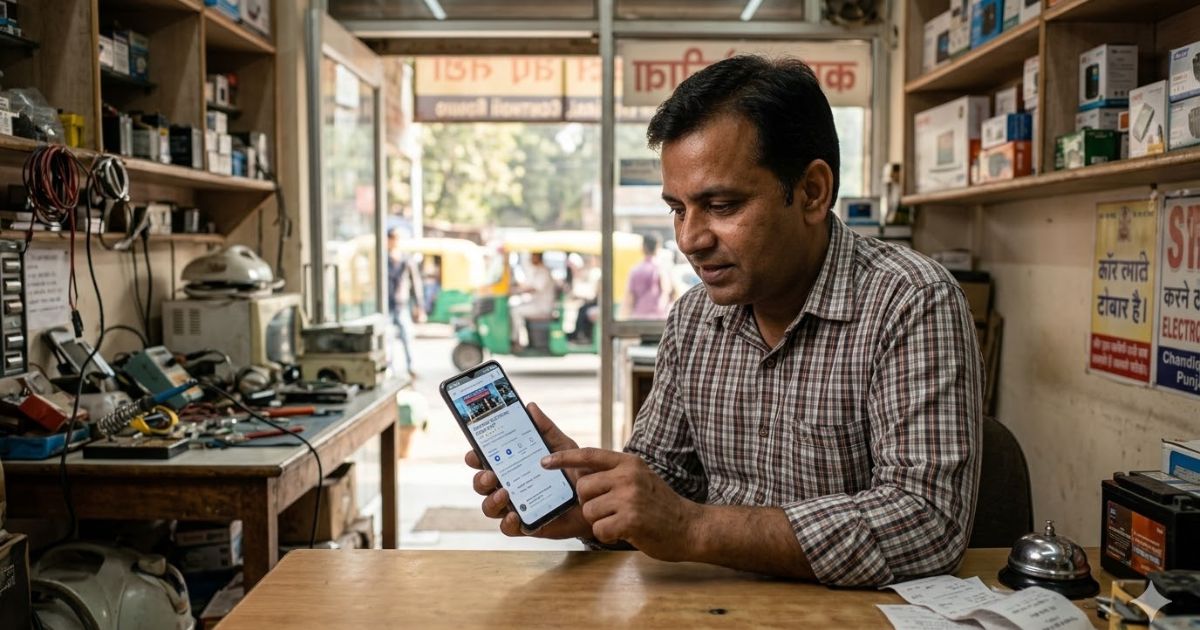

Ask a small business owner in Kanpur, Rajkot, or Madurai which platform they use to get customer enquiries online and most will say JustDial before they say Google. Ask an SEO professional the same question and they will look confused.
To someone working in digital marketing, Google Business Profile is the obvious answer. It is free, it is powerful, and it feeds directly into the most used search engine on the planet. How is JustDial, a platform that charges for leads and has been around since 1996, still the first choice for millions of Indian small businesses in 2026?
The answer is not that business owners are making the wrong decision. The answer is that JustDial and Google solved two very different problems, and for a large segment of Indian small businesses, JustDial solved the more relevant one first.
This post is part of a series on Why Most Indian Small Businesses Still Ignore SEO in 2026. If you want the full picture, start there.
A Quick History That Explains Everything
JustDial launched in 1996 as a telephone directory service. Long before smartphones, before Google Maps, before the concept of local search as we know it today, JustDial was the way Indian consumers found local businesses. You called a number, told them what you needed and where you were, and they gave you three options.
This was not a small operation. By the time smartphones arrived and Google became the dominant search engine globally, JustDial had already built a database of tens of millions of Indian businesses, a brand that Indian consumers recognised and trusted for local discovery, and a sales infrastructure that reached into every city and town in the country.
Google, by contrast, arrived in India as a global product. Powerful, technically superior in almost every way, but built for a global market and requiring businesses to set themselves up independently through an English-language interface designed primarily with Western markets in mind.
JustDial had a 15-year head start in the Indian market specifically. That head start did not disappear when Google became dominant globally.
The Six Reasons JustDial Still Wins With Indian Small Businesses
1. JustDial Goes to Them. Google Expects Them to Come.
This is the most fundamental difference and the one that explains adoption more than any other factor.
To get on JustDial, a business owner receives a call from a local JustDial sales representative. That representative speaks to them in their regional language, explains the product clearly, handles the entire setup process, and follows up to ensure the listing is active. The business owner does almost nothing except answer questions and agree to the terms.
To set up a Google Business Profile, a business owner needs to visit business.google.com, navigate an English-language interface, enter their business details correctly, verify their listing through a postcard or video call process, and then figure out how to optimise it from there. Nobody helps them. Nobody follows up. Nobody explains what the metrics mean.
For a business owner whose time is split between managing stock, serving customers, handling suppliers, and running daily operations, the path of least resistance wins every time. JustDial is the path of least resistance.
2. Results on a Timeline That Matches How Small Businesses Think
A business that lists on JustDial can receive a customer enquiry the same week. Sometimes the same day.
A business that sets up and optimises a Google Business Profile will typically wait 2 to 4 months before seeing meaningful movement in calls and direction requests from Google search.
This is not a small difference. For a business operating on weekly cash flow, the question is not which platform is better in 12 months. The question is which one generates a phone call this week. JustDial answers that question more directly and more immediately than Google can.
The ROI timeline of local SEO is structurally incompatible with how most small Indian businesses manage their finances. JustDial’s model of paid lead delivery on a short timeline fits the operational reality of a small business in a way that organic search simply cannot match.
3. Language and Accessibility
JustDial operates in Hindi and multiple regional languages. Its sales team communicates in the language of the business owner. Its interface is designed to be accessible to someone with basic smartphone literacy.
Google Business Profile is primarily an English-language product. While Google has improved regional language support over the years, the core interface, the help documentation, the support resources, and the default experience are all built for an English-comfortable user. For the majority of Indian small business owners who think and operate primarily in a regional language, this creates a meaningful barrier that JustDial does not.
4. Decades of Consumer Trust in Tier 2 and Tier 3 Markets
In India’s metros, Google Maps has largely displaced JustDial as the primary local discovery tool for consumers. A customer in Bangalore or Mumbai looking for a nearby restaurant or service provider is more likely to search Google Maps than call JustDial.
But in Tier 2 and Tier 3 cities, the story is different. JustDial built its brand in these markets over decades. Both consumers and businesses in these cities grew up using JustDial as the default local discovery tool. That familiarity and trust does not disappear overnight simply because a technically superior global product exists.
A business owner whose customers still use JustDial to find local services has a completely rational reason to prioritise JustDial over Google, regardless of what the aggregate data says about search engine market share.
5. Structured Lead Delivery vs Passive Visibility
JustDial’s paid model delivers leads directly. When a consumer searches for a service on JustDial, the platform calls the relevant businesses and connects them with the customer. The business does not need to have a great listing or optimised content. The platform does the matching and the connecting.
Google Business Profile creates visibility. A well-optimised GBP listing means a customer can find you and choose to call. But they have to find you first, your listing has to be compelling enough for them to choose you over competitors, and the entire burden of conversion is on the business.
For a business owner who is not thinking about conversion funnels and search behaviour, JustDial’s model is simply easier to understand. You pay, you get calls. The mechanism is transparent and direct.
6. The Network Effect of 25 Plus Years of Data
JustDial has been collecting data about Indian businesses, Indian consumers, and Indian local search behaviour for over 25 years. Its database of business listings, particularly in categories and geographies that Google’s crawlers have not fully indexed, is genuinely more complete than Google’s in some parts of the country.
In very localised markets, hyper-local service categories, or regions where internet penetration is more recent, JustDial’s ground-level data collection through its sales team has built a business directory that Google’s automated systems have not yet matched in depth.
Where Google Has the Clear Advantage
Acknowledging why JustDial wins with small businesses is not the same as saying JustDial is better. For most modern use cases, Google has significant advantages that compound over time.
| Advantage | Why It Matters |
|---|---|
| Search volume | The overwhelming majority of local searches in India happen on Google, not JustDial. A business visible on Google reaches a larger audience. |
| Cost over time | Google Business Profile is free. JustDial’s paid model means ongoing lead costs that never stop. A well-optimised GBP listing earns traffic at zero marginal cost indefinitely. |
| Trust signals for younger consumers | Urban consumers under 35 overwhelmingly use Google Maps for local discovery. As this demographic grows in purchasing power, Google’s advantage expands. |
| Integration with Maps and search | Google Maps integration means a business visible on GBP appears in navigation, directions, and map searches that JustDial cannot reach. |
| Review credibility | Google reviews are perceived as more trustworthy than JustDial reviews by most consumers because they are harder to game and more widely seen. |
| Long-term compounding | A well-maintained GBP and website with local SEO keeps earning visibility for years. JustDial visibility stops the moment you stop paying. |
The Answer Is Not Either/Or
The framing of JustDial versus Google is the wrong question for most Indian small businesses. The right question is which one to prioritise first given your specific situation, and whether you can build presence on both.
For a business in a Tier 2 city with an older customer base, tight cash flow, and no existing online presence, starting with JustDial makes sense. The setup is handled for you, the results come quickly, and the cost is predictable.
For a business in a metro with a younger customer base, higher-value transactions, and the ability to invest in a 6 to 12 month strategy, Google Business Profile and local SEO will deliver better long-term returns at lower long-term cost.
For businesses that can do both, the combination is stronger than either alone. JustDial delivers short-term leads while Google builds long-term organic visibility. Over 12 to 18 months, the Google investment starts compounding and the dependence on paid JustDial leads can gradually reduce.
The practical starting point: If you have never claimed your Google Business Profile, do that today regardless of whether you use JustDial. It is free, it takes 30 minutes, and it puts you in front of the growing majority of consumers who use Google Maps for local discovery. You do not have to choose between the two. Start with GBP as your free foundation and build from there.
What This Means for SEO Professionals Working With Indian Clients
If you are an SEO professional trying to convince an Indian small business owner to invest in local SEO, dismissing JustDial as irrelevant is the fastest way to lose credibility with that client.
JustDial is not irrelevant. For many of their customers, it has been the primary source of business enquiries for years. Telling them to abandon it in favour of something that will take 6 months to show results is not a compelling pitch.
The more effective approach is to position Google Business Profile as the free, long-term complement to JustDial rather than its replacement. Show them that their JustDial investment delivers short-term leads and their GBP investment builds the asset that reduces their dependence on paid leads over time. That is an argument a business owner can follow and agree with.
Meeting clients where they are, acknowledging what is already working for them, and showing how Google fits alongside it rather than replacing it is the honest and effective approach.
For the full analysis of why Indian small businesses approach digital marketing differently: Why Most Indian Small Businesses Still Ignore SEO in 2026.
Ready to set up your Google Business Profile the right way? Start with our Complete Local SEO Guide for Small Businesses.
Final Thought
JustDial is more popular than Google among Indian small businesses because it was built for Indian small businesses, by people who understood the Indian market, at a time when Google was not yet present. It solved the right problem in the right language at the right time.
Google is more powerful, more scalable, and more cost-effective in the long run. But power and cost-effectiveness are not the only factors a small business owner weighs when deciding where to invest their time and money.
Understanding why JustDial won is not an argument against Google. It is the context any SEO professional needs to have an honest, productive conversation with an Indian small business owner about where to build their online presence.