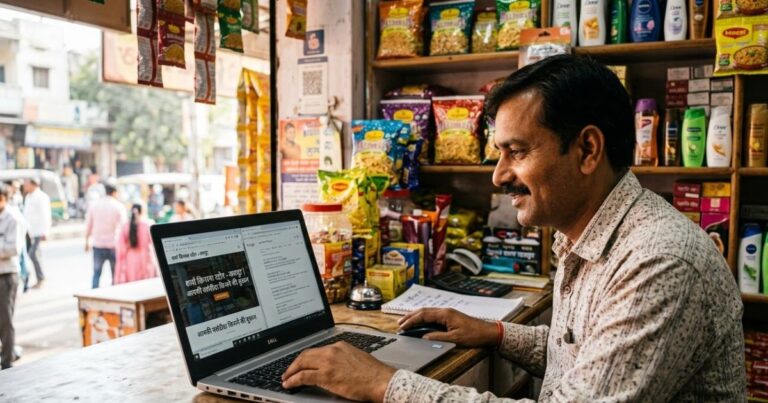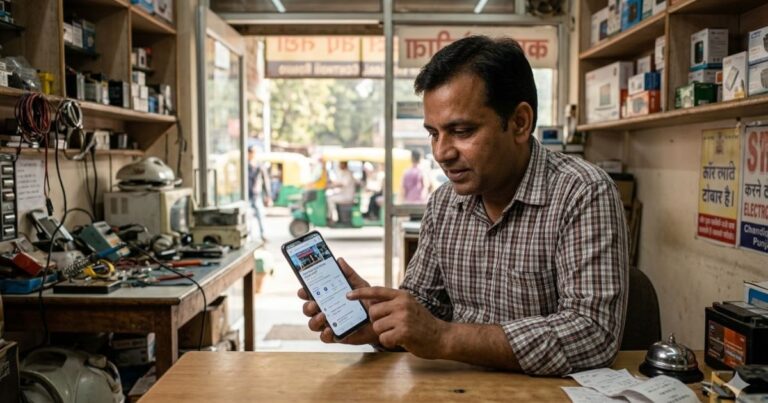

India has over 63 million micro, small, and medium enterprises. It has the third-largest startup ecosystem in the world. Mobile internet penetration crossed 700 million users. And yet, walk into any market street in Ludhiana, Surat, Coimbatore, or Bhopal, and the overwhelming majority of small business owners have no meaningful presence on Google.
This is not ignorance. It is not backwardness. It is a set of very specific, very rational barriers that explain why a country with one of the most digital-hungry populations on the planet has an MSME sector that largely operates as if search engines do not exist.
Understanding those barriers properly is more useful than simply observing that the gap exists.
Barrier 1: The Awareness Gap Is Real, But It Is Not What You Think
The easy answer is that small business owners in India simply do not know what SEO is. That is partially true but it misses the more important point.
Most Indian small business owners are aware that Google exists. They use it themselves. Many of them have been approached by digital marketing agencies and freelancers promising Google rankings. The awareness problem is not that they have not heard of SEO. It is that what they have heard has been confusing, contradictory, or actively misleading.
A kirana store owner in Nagpur who has been approached three times by agencies promising ‘page one of Google in 30 days’ for fees he cannot verify and results he cannot measure has not made an irrational decision when he says no. He has made a completely rational one based on the information available to him.
The awareness gap in Indian small business SEO is not a lack of knowledge that search engines exist. It is a lack of trust in the people who claim to be able to help with them. Those are very different problems with very different solutions.
Barrier 2: The ROI Horizon Does Not Match How Small Businesses Operate
SEO is a long-term investment. Results typically take 3 to 6 months to become visible and 6 to 12 months to become meaningful. For a small business operating on thin margins with immediate cash flow pressures, this timeline is genuinely incompatible with how they make spending decisions.
A small business owner in India is not thinking in quarterly marketing budgets. They are thinking in weekly cash flow. Every rupee spent needs to show a return in a timeframe they can see and measure. Paying a monthly retainer for SEO services while watching their Google ranking stay flat for 4 months is not something most small businesses can absorb financially or psychologically.
Compare this to JustDial or IndiaMart, where a paid listing delivers a phone call the same week. Or to a WhatsApp status that reaches existing customers immediately. Or to a board outside the shop that a passerby reads today. These channels have an ROI timeline that matches the operational reality of a small business. SEO does not.
| Channel | ROI Timeline for a Small Indian Business |
|---|---|
| SEO | 3 to 12 months for visible results, compounds over time, requires consistent investment before returns appear |
| JustDial paid listing | Enquiries possible within the same week, direct lead generation, measurable immediately |
| WhatsApp marketing | Reaches existing customers same day, free or near-free, measurable in responses |
| Google Ads | Traffic from day one, fully measurable, scalable but requires ongoing spend |
| Word of mouth and referrals | Immediate, free, trusted, has always worked and continues to work in tight-knit local markets |
This is not an argument that SEO has no value for Indian small businesses. It has enormous value. It is an honest acknowledgement that the investment profile of SEO is structurally misaligned with how most small Indian businesses manage their finances. Any honest conversation about SEO adoption has to start here.
Barrier 3: The Language Barrier Is Larger Than SEO Professionals Acknowledge
The majority of SEO content, tools, case studies, and education is in English. The majority of Indian small business owners are not comfortable operating primarily in English.
This creates a compounding problem. The business owner cannot easily research what SEO is in their own language. The tools they would use to implement it have English interfaces. The agencies and freelancers they encounter often communicate in English-heavy jargon. The result is that SEO feels like a foreign discipline designed for a different kind of business, not something that applies to a saree shop in Varanasi or a hardware store in Rajkot.
Hindi, Tamil, Telugu, Marathi, Bengali, Kannada, Gujarati content about practical SEO for small businesses is thin to nonexistent in quality. There is no Indian-language equivalent of the kind of straightforward, practical SEO education that exists in English. That is not a small gap. It is a structural exclusion of the majority of Indian small business owners from the conversation entirely.
The dominance of English in SEO education is not just a convenience issue for Indian small businesses. It is a signal that the discipline was built for, and largely by, businesses operating in English-speaking markets. Genuine SEO adoption in India requires SEO education in Indian languages, not just translated versions of Western guides.
Barrier 4: The Trust Deficit Created by the Indian Digital Marketing Industry
This is the barrier that the digital marketing industry in India least wants to talk about, and it may be the most significant one.
The Indian digital marketing space, particularly at the small business level, has a serious quality and trust problem. The market is flooded with agencies, freelancers, and self-described experts who promise guaranteed rankings, instant results, and page-one placement for fees that sound reasonable to a small business owner but are economically impossible to deliver on honestly.
What typically happens: a business owner pays a monthly fee, receives a report full of metrics they cannot interpret, sees no meaningful change in enquiries or footfall, and eventually stops paying. They leave the experience believing that SEO does not work, that it is a scam, or that it is only for large businesses.
This is not a fringe experience. It is the dominant experience of small Indian businesses that have tried SEO services. The stories travel. A shopkeeper who tried SEO and got burned tells his neighbouring shopkeepers. The trust damage is not individual, it is communal.
| Common promise or practice | Why it damages trust |
|---|---|
| Guaranteed first page rankings | No ethical SEO professional can guarantee specific rankings. Google controls rankings. Anyone guaranteeing them is either lying or using tactics that will eventually cause penalties. |
| Results in 30 days | Meaningful organic results in 30 days for a new or unestablished website are almost impossible. This promise sets expectations that cannot be met. |
| Hundreds of backlinks per month | Mass link building at low cost is either spam or purchased links. Both create risk of Google penalties that damage rather than help the site. |
| Reporting with traffic numbers but no business outcomes | A report showing ‘keyword rankings improved’ that the business owner cannot connect to actual enquiries or sales is not accountable marketing. It is covering tracks. |
| Low monthly retainers that cannot fund quality work | Genuine SEO work requires time and expertise. A retainer priced below the market rate for that time cannot deliver quality work. It will be automated, outsourced to low-quality labour, or simply not done. |
Barrier 5: Alternative Platforms Fill the Gap Effectively Enough
For many Indian small businesses, Google is not actually their primary customer acquisition channel, and it does not need to be. JustDial, IndiaMart, Zomato, Swiggy, Urban Company, OLX, and WhatsApp collectively serve the local discovery and lead generation needs that SEO would otherwise fill.
A plumber in Chennai who gets steady work through JustDial and word of mouth has no urgent reason to invest in SEO. A restaurant in Pune that generates consistent orders through Zomato and Swiggy does not feel the absence of organic Google rankings. A tuition centre in Hyderabad whose classes fill every year through parent referrals and neighbourhood awareness is not losing sleep over its GBP optimisation.
These platforms work. They have local sales teams who onboard small businesses in their own language. They have business models designed for the Indian market. They require no technical knowledge. They deliver results on a timeline that matches how small businesses think about spending.
SEO competes with platforms that have very deliberately and very successfully solved the problems that make SEO hard for small Indian businesses. Understanding that is essential context for why adoption is low.
Barrier 6: The Cost Structure of Good SEO Is Prohibitive at Small Business Scale
Genuine, effective SEO for a small business requires at minimum: a functional website with proper technical foundations, consistent content creation over months, citation building across relevant directories, and either significant time investment from the owner or a competent paid professional.
For a business turning over a few lakhs per month, allocating a meaningful budget toward something with a 6 to 12 month payback period is a significant financial commitment. And because the quality of available services is so variable, the risk of that investment producing nothing is genuinely high.
The small businesses that do invest in SEO successfully in India tend to share a few characteristics: they are in industries where high-value customers search online before buying (healthcare, legal, real estate, education), they have slightly longer-term thinking than the average small business owner, and they either have someone in-house who understands digital or they found a trustworthy agency through a personal referral rather than a cold call.
What Would Actually Change This
The question is not just why adoption is low. The more useful question is what conditions would change the adoption curve. Based on the barriers above, the answers are fairly specific.
SEO education in Indian languages: Practical, jargon-free content about what Google Business Profile is and how to use it, written in Hindi, Tamil, Telugu, and other major languages. This does not exist at scale and it is a genuine gap.
Honest expectation setting from the SEO industry: If the industry stopped promising 30-day results and started explaining the real 6 to 12 month investment timeline honestly, fewer businesses would feel burned. The short-term dishonesty is damaging the long-term market.
Outcome-based pricing models: A monthly retainer with no measurable outcome accountability is a trust problem. SEO services priced around demonstrable business outcomes, calls from GBP, direction requests, new patient enquiries, would align incentives with small business owners in a way that retainer models do not.
Google’s own education efforts in India: Google has run Business Profile workshops and Digital Unlocked programs in India. These initiatives have reached millions of small businesses but have not translated into widespread, sustained SEO adoption. The gap between creating a GBP listing and actually optimising it for local search remains poorly bridged.
A generation shift in business ownership: The fastest driver of SEO adoption in Indian small businesses is the handover of family businesses to younger family members. A 28-year-old who grew up with smartphones taking over a father’s hardware store is far more likely to invest in digital presence than the founder who built the business on personal relationships and reputation. This is happening organically and it is the most reliable long-term driver of change.
The Opportunity Side of the Same Coin
Everything in this article that explains why Indian small businesses ignore SEO also explains why the opportunity for those who do invest is so large.
In a market where your competitor has not claimed their Google Business Profile, has no reviews, has no website, and is not appearing in local search results, the bar for visibility is extremely low. You do not need to outrank established national brands. You need to be the only local business in your category that Google can confidently show.
In Tier 2 and Tier 3 cities especially, a dental clinic, a coaching centre, a CA firm, or a salon that has a complete GBP listing, 30 genuine reviews, and basic website optimisation is likely the best-optimised business in its category within a 5 km radius. Not because they have done a lot. Because almost everyone else has done nothing.
The adoption gap is a problem for the industry. For individual businesses willing to invest where their competitors will not, it is a sustained competitive advantage that compounds every month they maintain it.
The gap between India’s digital growth story and its MSME sector’s SEO adoption is not a paradox. It is the predictable result of a specific set of structural barriers that have never been properly addressed.
Understanding those barriers is the starting point for anyone who wants to help Indian small businesses grow through search, whether as an SEO professional, an educator, a platform, or a business owner trying to understand why their competitors are not on Google.
The opportunity is real. The barriers are real. Acknowledging both honestly is more useful than either celebrating the potential or dismissing the obstacles.
If you are a small business owner trying to understand where to start with Google: Complete Local SEO Guide for Small Businesses.
If you want to understand what local SEO is and how it differs from regular SEO: Local SEO vs Traditional SEO.
Frequently Asked Questions
Yes, but the honest answer depends on the type of business and the competitive environment. For businesses in industries where customers search before buying (healthcare, legal, education, food, local services), SEO delivers compounding long-term returns that paid advertising cannot match in cost efficiency. For businesses in categories dominated by platforms like JustDial or Zomato, the starting point is claiming and optimising listings on those platforms first, then building a broader SEO presence. The most visible local businesses in India typically do both.
Because Google’s ranking systems are built around trust, and trust is earned over time. When you publish a new page, Google needs to crawl it, index it, assess its relevance and quality, compare it against competing pages, and determine how much trust to assign to your domain. This process takes weeks at minimum and months for competitive keywords. The work is front-loaded, meaning you invest now and earn results over the following 6 to 12 months. Once rankings are established they are far more durable and cost-efficient than paid advertising.
Absolutely. The foundational actions that move the needle for a small local business in India — claiming and completing a Google Business Profile, ensuring consistent NAP across directories, getting genuine customer reviews, and having a functional mobile-friendly website — require no technical expertise and no agency. These actions alone put most small businesses ahead of local competitors who have done nothing. Hiring an agency becomes valuable when the basics are already in place and you want to compete for more competitive keywords or build content at scale.
There is no fixed answer because it depends on your goals and your competitive environment. For a local business targeting customers within a 10 km radius in a Tier 2 city, foundational SEO work can be done with zero agency spend if the owner is willing to invest time. For competitive metro markets, a realistic monthly agency retainer for genuinely quality work starts at Rs 15,000 to Rs 25,000. The danger zone is the Rs 3,000 to Rs 8,000 per month market, where the economics make quality work impossible and where most of the trust damage described in this article originates.
JustDial was built specifically for the Indian market and solved the local business discovery problem before smartphones were widespread. It has a local sales team that onboards businesses in regional languages, a business model that delivers leads quickly, and strong brand recognition in tier 2 and tier 3 markets. Google Business Profile requires the owner to set it up themselves, in English, using an interface designed for a global market. JustDial met Indian small businesses where they were. Google largely has not, at least not yet.
Yes, and this is one of the most underutilised opportunities in Indian digital marketing. A significant and growing portion of Google searches in India happen in Hindi, Tamil, Telugu, Bengali, Marathi, and other regional languages. Content optimised for these searches faces dramatically lower competition than English-language content on the same topics. A business that creates content for regional language searches is often the only result Google has to show for that query. The competition is not just lower, it is often nonexistent.
Google Ads delivers traffic immediately but stops the moment you stop paying. SEO delivers traffic slowly but keeps compounding even after you reduce your investment. For a business with immediate cash flow needs, Google Ads makes more sense. For a business thinking in 12 to 24 month terms, SEO builds an asset rather than renting visibility. The most effective approach with a limited budget is to use Google Ads to generate immediate leads while simultaneously building SEO foundations, then shift budget from Ads to SEO as organic rankings start delivering traffic independently.
Because it sells. A business owner who does not fully understand how rankings work is more likely to sign with an agency that guarantees page one placement than one that honestly explains a 6 to 12 month timeline with no guarantees. Google explicitly states that no one can guarantee rankings. Any agency making this promise is either misleading the client, planning to use manipulative tactics that risk penalties, or using a definition of ranking that is technically true but meaningless, such as ranking for a keyword nobody actually searches.
The clearest indicator is whether reports connect to business outcomes you can verify. A report showing keyword rankings and backlinks built is not accountability. The real questions are: Are more customers calling from Google? Are direction requests to your location increasing? Is organic traffic growing? Are new enquiries mentioning Google as the source? If your agency cannot connect their work to any of these outcomes after 6 months, the work is either not being done or not being done correctly. Always insist on access to your own Google Business Profile and Google Search Console directly.
AI is changing how search results are displayed, with Google’s AI Overviews now appearing above traditional results for many queries. However, the underlying signals Google uses to determine which businesses to trust remain the same: genuine relevance, consistent presence, authentic reviews, and content that answers real questions. If anything, businesses that have built genuine local authority through consistent citations, real reviews, and helpful content will benefit most. Businesses that relied on low-quality tactics will find those tactics becoming even less effective.