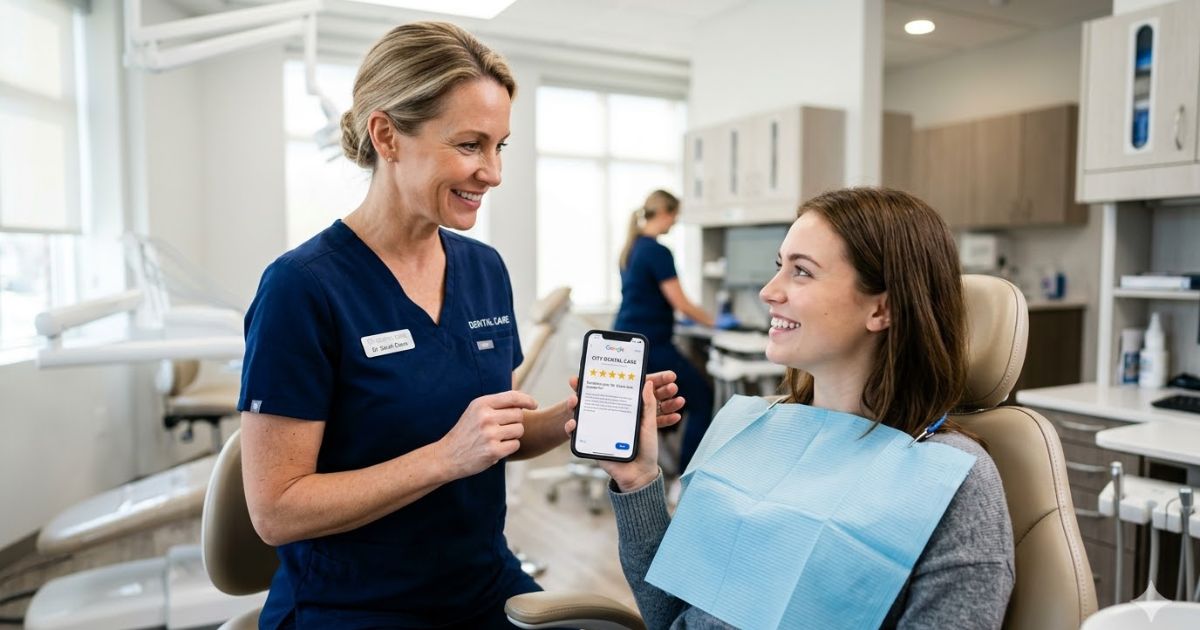

Dental patients read reviews differently to almost any other consumer. When someone is choosing a restaurant, they skim ratings. When they are choosing a dentist, they read. They are looking for specific reassurance , that you are gentle, that you explain things clearly, that the clinic is clean and modern, that you are good with nervous patients.
A dental clinic with 200 genuine reviews that mention these things is almost unconquerable in the local Map Pack. Google sees the volume and velocity of reviews as a ranking signal. Patients see the content of those reviews as the deciding factor between booking you or someone else.
Most dental clinics get reviews slowly and randomly. A patient has a great experience, remembers to leave a review two weeks later, and writes something generic. That is not a review system. This guide gives you the actual system.
This guide is part of our complete Local SEO for Dentists series.
Why Reviews Work Differently for Dental Clinics
For most local businesses, a review is a trust signal. For dental clinics, a review is a conversion mechanism. The difference matters for how you approach getting them.
A patient considering your clinic faces a set of specific anxieties: Will it hurt? Will they judge me for not having been in years? Will I understand what they are telling me? Is it going to cost more than I expect? Will the dentist be patient if I am nervous?
A review that says ‘great dentist, highly recommend’ answers none of those questions. A review that says ‘I had not been to a dentist in eight years because of anxiety, and the team at City Dental were so patient and kind, they explained every step and I felt completely at ease’ answers all of them.
Your review strategy needs to be built around getting the second type, not just the first.
Part 1: How to Ask for Reviews
The Right Moment
Timing a review request in dentistry is more specific than in most businesses because the emotional arc of a dental appointment is unique. At the start the patient is often nervous. During treatment they are focused on getting through it. Immediately after, when it has gone well, there is a window of genuine relief and goodwill that closes within an hour.
That window is your moment.
Ask at checkout, before the patient leaves reception. Not by email the next day. Not by text a week later. At the front desk, in person, right after a successful appointment while they are still feeling the relief.
The exact moment: The receptionist handles checkout. The appointment went well. The patient says something like ‘That was much better than I expected.’ That sentence is your cue. That is the ask.
What the Receptionist Should Say
The ask needs to feel natural, not scripted. Here is a framework that works:
‘Really glad it went well for you today. If you ever have a spare moment, a Google review from you would genuinely help other patients who are nervous about coming in find a clinic they can trust. Even just a few sentences makes a real difference.’
Why this works: it validates the patient’s experience, it frames the review as helping other people rather than marketing your business, and it does not put pressure on them. It is a request, not a demand.
What to avoid:
- ‘Please leave us a 5-star review’ , asking for a specific rating violates Google’s guidelines and feels transactional
- ‘Can you leave us a review right now?’ , rushing patients feels pushy and the review written under pressure is usually generic
- Handing them a tablet or phone to write the review in reception , patients feel put on the spot and the review is brief and forgettable
The Follow-Up Text Message
If your practice management software holds patient contact details and they have opted into communications, a follow-up text message sent 2 to 3 hours after the appointment catches patients while the experience is still fresh but they now have a moment to themselves.
‘Hi [name], great to see you today. If you have a moment, a Google review would mean a lot to us and helps other patients in [city] find a dentist they can trust. Here is the link: [direct review link]. No pressure at all, just grateful if you have a minute.’
The direct link is important. Do not send patients to your homepage and expect them to find the review button. Generate your direct Google review link from your GBP dashboard and use that link every time. One tap, straight to the review box.
Check your country’s patient communication regulations before sending appointment follow-up texts. In many countries, patients must have explicitly opted into marketing communications. Using clinical appointment data for review requests sits in a grey area in some regions. Check with your practice manager or a healthcare compliance adviser if you are unsure.
Email Follow-Up for Longer Treatments
For treatments that span multiple appointments , orthodontics, implants, full smile makeovers , the right moment to ask for a review is at the final appointment when the patient sees their completed result. That is the peak emotional moment of the entire treatment journey.
For these patients, a follow-up email the day after completion works well because the result is still new, they are likely showing people their smile, and they are in the mindset of reflecting on the experience.
Subject: Thank you for trusting us with your smileHi [name],It was such a pleasure completing your [treatment] yesterday. Seeing your reaction when you saw the result is exactly why we love what we do.If you have a moment, we would be so grateful if you shared your experience in a Google review. Your words genuinely help other patients in [city] who are considering [treatment] find a clinic they can feel confident about.[Direct review link]Thank you again.[Dentist name] and the team at [Clinic Name]
Part 2: How to Get Reviews That Do SEO Work
A generic 5-star review with no text is a trust signal. A review that mentions your location, a specific treatment, and a specific quality of care is a trust signal and a ranking asset. The difference is in how you ask.
The Treatment-Specific Ask
When asking for a review, name the treatment the patient just had. This is not scripting their words. It is giving them a starting point that makes writing the review easier and naturally produces content that contains your treatment keywords.
| Treatment | Natural Review Prompt |
|---|---|
| After teeth whitening | ‘If you mention the whitening in your review it helps other patients searching for teeth whitening in [city] find us.’ |
| After dental implants | ‘A lot of our implant patients searched for a long time before finding someone they trusted. A review about your experience would genuinely help someone in the same position.’ |
| After root canal | ‘Root canal has such a bad reputation and you handled it so well. If you felt it was better than you expected, saying that in a review would really reassure other nervous patients.’ |
| After Invisalign completion | ‘Other patients considering Invisalign in [city] would really benefit from hearing about your experience from start to finish.’ |
| After a first nervous patient visit | ‘If you felt more at ease than you expected, that is exactly what other nervous patients are hoping to read before they choose a dentist.’ |
Why treatment-specific reviews compound over time:
Google indexes the text of your reviews. A review mentioning ‘dental implantsin Austin’ is not just a trust signal for a human reader.It is content that Google associates with your listing for that keyword.
A clinic with 40 reviews mentioning ‘teeth whitening [city]’, ‘dental implants [city]’,’nervous patient’, and ‘painless root canal’ is sending Google a continuous streamof keyword-relevant content from real patients.
A clinic with 40 generic 5-star reviews with no text is sending almost nothing.
Same review count. Completely different ranking impact.
Part 3: How to Respond to Reviews
Your response to every review is public. Potential patients read your responses as carefully as they read the reviews themselves. A thoughtful, personal response to a negative review often converts more patients than ten positive ones.
Responding to Positive Reviews
Most clinics respond to positive reviews with ‘Thank you so much!’ and nothing else. That is a missed opportunity. A well-written response to a positive review does three things:
- It reinforces the patient’s experience and makes them feel valued
- It signals to potential patients reading the reviews that you are attentive and personal
- It contains naturally written keywords that Google indexes
| Type | Example and Explanation |
|---|---|
| Generic response to avoid | ‘Thank you for your lovely review! We really appreciate it.’ |
| Better response | ‘Thank you so much [name]. We are so pleased your root canal appointment went smoothly. We know how much people dread root canal treatment and it always makes our day when a patient leaves feeling relieved rather than stressed. Looking forward to seeing you at your next checkup at our [city] clinic.’ |
| Why the better response works | It contains: root canal treatment, patient anxiety angle, clinic city. It sounds human. It gives the patient a specific acknowledgement. It is the kind of response a potential nervous patient reads and thinks ‘this clinic actually cares.’ |
Responding to Negative Reviews
A negative review on a dental clinic’s GBP listing is read very carefully by potential patients. They are not just reading the complaint. They are watching how you handle it. A calm, professional, empathetic response to a negative review consistently converts more patients than a defensive or dismissive one.
The framework for responding to any negative review:
- Acknowledge the patient’s experience without admitting liability
- Express genuine concern that they did not have the experience they deserved
- Invite them to contact you directly to discuss and resolve it
- Never mention clinical details about the patient publicly
Example: ‘Thank you for sharing your experience [name]. This is not the standard of care we aim to deliver, and we are genuinely sorry to hear your visit did not meet your expectations. We would really like the opportunity to understand what happened and make it right. Please call us directly at [phone number] and ask to speak with our practice manager. We take all feedback seriously and we want to resolve this for you.’
Never respond to a negative review by disputing clinical details, identifying what treatment the patient had, or disclosing any information about their visit. Patient confidentiality applies even in public review responses. Keep every response focused on your willingness to resolve the issue, not on defending what happened.
Part 4: Platforms Beyond Google
Google reviews are the priority. But patients also check other platforms, and reviews there function as citations that support your overall local authority.
| Platform | Why It Matters for Dental |
|---|---|
| Google Business Profile | The highest priority. Directly impacts your Map Pack ranking and is the first review source most patients check. |
| Healthgrades (US) | Specialist platform for healthcare providers. Patients specifically searching for a dentist’s credentials and ratings will check here. |
| Zocdoc (US) | Patients who book through Zocdoc leave reviews there. High-intent, verified patient reviews. |
| Practo (India) | The dominant healthcare review platform in India. Essential for any dental clinic serving the Indian market. |
| RateMDs | Dental and medical review platform used across multiple markets. Worth maintaining. |
| Yelp | High-authority citation and review platform. Reviews here also feed into Apple Maps. |
| Some patient demographics check Facebook reviews specifically, particularly older patients. | |
| TripAdvisor | Less relevant for dental but useful in tourist-heavy locations where travellers need emergency dental care. |
Part 5: What Never to Do
These practices are common, and every one of them creates more problems than it solves.
Buying reviews: Google detects patterns in fake reviews with increasing accuracy. A sudden spike of reviews from accounts with no history, posted within a short window, is a pattern Google recognises. The penalty is review removal and in serious cases a listing suspension. No ranking gain is worth that risk.
Asking patients to change or remove negative reviews: This is against Google’s policy and damages patient relationships. The correct response to a negative review is to resolve the issue and let the patient decide independently whether to update their review.
Incentivising reviews: Offering a discount, gift, or any benefit in exchange for a review violates Google’s guidelines and the advertising standards regulations in most countries. Even ‘enter our prize draw when you leave a review’ is non-compliant.
Review gating: Sending only happy patients a review link and filtering out unhappy ones before asking. This is against Google’s guidelines and creates an artificially skewed review profile that Google’s systems are increasingly able to detect.
Responding to negative reviews with clinical details: Patient confidentiality applies everywhere, including public review responses. Never mention a patient’s treatment, diagnosis, or any clinical information in a public reply.
The 90-Day Review Sprint
If your clinic has fewer than 25 Google reviews, here is a structured plan to build your review foundation in 90 days without any of the risky tactics above.
| Period | Action |
|---|---|
| Days 1 to 7 | Generate your direct Google review link from GBP dashboard. Train every receptionist on the in-person ask using the framework in this guide. Brief every dentist on the treatment-specific prompt table. |
| Days 8 to 30 | Ask every patient at checkout. No exceptions. Even long-term patients who have never left a review. Track how many asks are made versus how many reviews come in. Your baseline conversion rate is typically 20 to 30%. |
| Days 31 to 60 | Add the post-appointment text message for patients who consented to communications. Monitor for any review mentioning a treatment and add a keyword-rich response within 24 hours. |
| Days 61 to 90 | For any patient who had a significant treatment completion (implants, Invisalign final, full smile makeover) in the last 6 months and has not left a review, send a personalised email using the template in this guide. |
| After 90 days | Review volume and velocity should be consistently growing. Maintain the weekly habit. A clinic asking every patient, every day, compounding over a year, will have a review profile that no competitor who asks occasionally can match. |
Final Thought
Reviews for a dental clinic are not marketing collateral. They are the honest voice of patients who chose to trust you and had a good enough experience to say so publicly.
Build the habit of asking every patient, every day. Give them a clear, easy path to leave a review. Respond to everything that comes in. Do those three things consistently for a year and your review profile will become one of the strongest competitive assets your clinic has.
No competitor who asks occasionally will ever catch up.
Explore for more such info – thejatinagarwal.in and for more guides covering specific Google Business Profile issues, troubleshooting steps, and local SEO strategies, browse our complete Local SEO resource hub.