
If you have ever Googled anything about SEO, you have probably come across both terms, Local SEO and Traditional SEO (also called Organic SEO). They sound similar. They both involve Google. And they both promise to get you more traffic and customers.
But they are not the same thing. They have different goals, different methods, and they work for different types of businesses. Mixing them up – or worse, doing one when you actually need the other, is one of the most common reasons businesses spend money on SEO and see no results.
This guide is going to break down exactly what each one is, where they overlap, how they differ, and most importantly, which one your business needs right now.
What is Traditional SEO?
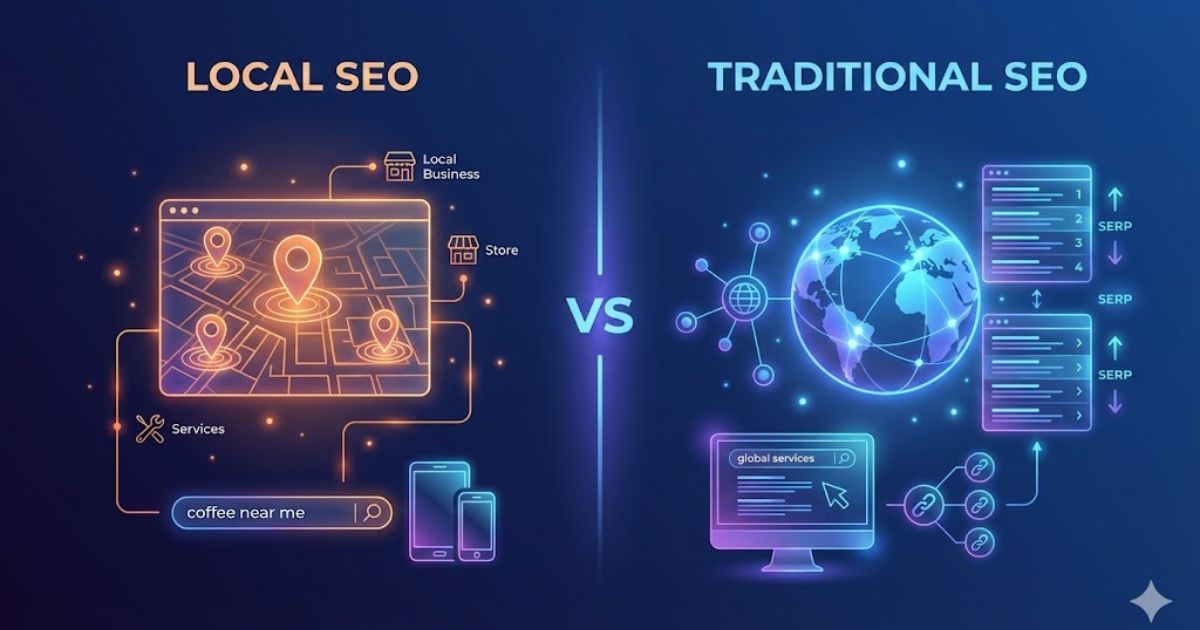
Traditional SEO, often called Organic SEO – is the process of getting your website to rank higher in Google’s regular search results for keywords that are not tied to a specific location.
If someone searches ‘how to start a podcast’, ‘best project management software’, or ‘what is compound interest’, those are non-local searches. The person could be anywhere in the world. They are not looking for a business near them, they are looking for information, a product, or a service that can be delivered anywhere.
Traditional SEO is what you use to compete for those searches. It focuses heavily on:
- Creating high-quality content that answers what people are searching for
- Building backlinks from other websites to establish your site’s authority
- Technical website optimisation; speed, structure, mobile-friendliness
- Ranking in the standard blue-link search results that appear below any ads
Think of Traditional SEO as competing nationally or globally. Your competition is every other website on the internet that targets the same keywords, regardless of where they are based.
What is Local SEO?
Local SEO is the process of getting your business to show up when someone nearby searches for what you offer. The key word is nearby.
When someone searches ‘dentist near me’, ‘best pizza in Austin’, or ’emergency plumber open now’, Google shows results based on location, specifically the Map Pack (the box with three businesses and a map) and locally relevant website results.
Local SEO focuses on making sure your business appears in those location-based results. It works through:
- Optimising your Google Business Profile, the single biggest factor in local rankings (full guide here)
- Building consistent citations across directories, your business name, address, and phone number listed correctly everywhere
- Getting Google reviews and responding to them
- Creating location-specific pages and content on your website
- Building backlinks from local websites and organisations
Think of Local SEO as competing in your city or neighbourhood. Your competition is only the businesses near you that offer the same service – not every business in the world.
Local SEO vs. Traditional SEO: Side by Side
Here is a clear comparison across the factors that matter most:
| Factor | Local SEO | Traditional SEO |
|---|---|---|
| Goal | Appear in local map and search results | Rank in national/global search results |
| Target audience | People searching nearby, ready to buy | Anyone searching, anywhere in the world |
| Where you appear | Google Map Pack + local organic results | Regular organic search results (blue links) |
| Key ranking tool | Google Business Profile | Your website and its content |
| Most important signal | Reviews, citations, GBP activity | Backlinks, content quality, site authority |
| Best for | Brick-and-mortar and service-area businesses | E-commerce, SaaS, blogs, national brands |
| Speed of results | Faster, 4 to 12 weeks with good GBP | Slower, 3 to 12 months typically |
| Competition | Only local businesses in your area | Every website globally targeting same keyword |
| Search intent | High, people want to visit or call soon | Varies – informational, research, or purchase |
The Real Difference Nobody Talks About: Search Intent
The comparison table above is useful, but here is the thing that truly separates Local SEO and Traditional SEO at their core, it is not the tactics, it is the intent of the person searching.
Local searches have immediate, high purchase intent
When someone types ‘plumber near me’ at 9pm on a Tuesday, they are not doing research. Their pipe is leaking. They need someone now. They are going to call the first business that looks trustworthy in the Map Pack.
That is the power of Local SEO. You are reaching people at the exact moment they need what you offer, in the exact place you operate. The conversion rate from local search traffic is dramatically higher than almost any other marketing channel.
Traditional searches are often earlier in the journey
When someone types ‘how to fix a leaking pipe’, they might be trying to fix it themselves. They are not necessarily ready to call a plumber. Traditional SEO captures people earlier, in the research phase, which is valuable but requires a longer path to conversion.
A plumbing company could write a blog post targeting ‘how to fix a leaking pipe’ using Traditional SEO, and that post might get thousands of readers, but only a fraction will turn into customers. Compare that to ranking in the Map Pack for ‘plumber near me’, where nearly every person who clicks is ready to book.
This is why Local SEO almost always delivers faster, more direct business results for small businesses than Traditional SEO does. You are closer to the moment of decision.
Which One Does Your Business Actually Need?
Here is a simple way to think about it:
You need Local SEO if:
- You have a physical location that customers visit – a shop, restaurant, clinic, salon, gym
- You travel to customers in a specific area, a plumber, electrician, cleaner, landscaper
- Most of your customers come from within your city or region
- Your service cannot be delivered remotely or nationally
- You are competing against other businesses in the same town or neighbourhood
Examples: restaurants, dentists, lawyers, plumbers, electricians, estate agents, gyms, hairdressers, mechanics, chiropractors, pet groomers, tutors, cleaning services.
You need Traditional SEO if:
- You sell products or services that can be delivered anywhere, an online shop, a SaaS tool, a course
- Your customers can be from any city, country, or region
- You earn revenue from website traffic itself – a blog, a media site, an affiliate site
- Your business does not have a specific physical location that matters to customers
Examples: e-commerce stores, software companies, online course creators, national retailers, digital agencies, bloggers, news sites.
Most Small Businesses Need Both – But in the Right Order
Here is the honest answer for most local business owners: you need both, but Local SEO should come first.
Why? Because Local SEO delivers results faster, targets people with higher purchase intent, and directly drives calls, visits, and bookings. Traditional SEO through blog content builds over months and years and drives more awareness-stage traffic.
The right sequence for a local business is:
- Step 1: Get your Local SEO foundation in place – Google Business Profile, citations, reviews, location pages on your website
- Step 2: Once your Map Pack ranking is solid and you are getting consistent local traffic, start building Traditional SEO through blog content that targets informational keywords in your industry
- Step 3: The two strategies reinforce each other, your blog content builds website authority, which helps your local rankings too
Real example: A dentist in Chicago should first focus entirely on ranking in the Map Pack for ‘dentist near me’ and ‘Chicago dentist’. Once that is working, they can start writing blog posts like ‘How often should you get a dental checkup?’ or ‘What to do when a tooth is knocked out’ – building website authority while also capturing people earlier in the research phase.
Where Local SEO and Traditional SEO Overlap
They are not completely separate worlds. Several things matter for both, and doing them well improves both your local and organic rankings at the same time:
Your website: Both types of SEO depend on having a well-built, fast, mobile-friendly website. A slow or broken website hurts your local rankings just as much as your organic ones.
On-page optimisation: Title tags, meta descriptions, heading tags, and keyword placement on your pages matter for both. A properly optimised service page helps you rank locally AND organically.
Backlinks: Links from other websites build authority that helps both local and traditional rankings. A backlink from a local news site helps your Map Pack ranking. A backlink from an industry blog helps your organic ranking. The best links do both.
Content quality: Google rewards useful, well-written content in both types of search. Thin, low-quality pages perform poorly whether they are local service pages or blog posts.
Technical SEO: Page speed, mobile optimisation, proper indexing, and site structure matter for both. Fix the technical foundations and both strategies benefit.
The Most Common Mistakes Businesses Make with These Two
Mistake 1: Focusing only on Traditional SEO when they need Local SEO: A local restaurant spending months trying to rank for ‘best pasta recipes’ instead of ‘Italian restaurant in [their city]’ is a very real mistake. Know your customer’s actual search behaviour before investing in content.
Mistake 2: Ignoring their Google Business Profile while working on their website: For a local business, a neglected GBP can cost more rankings than a poorly built website. The GBP is the most direct path to Map Pack visibility, it deserves attention before anything else.
Mistake 3: Treating them as completely separate strategies: Some businesses run their Local SEO and their blog content as if they have nothing to do with each other. In reality, every blog post builds domain authority that benefits local rankings, and every local citation reinforces the credibility of the website. Think of them as one integrated strategy.
Mistake 4: Expecting Traditional SEO timelines from Local SEO (or vice versa): Local SEO improvements to your GBP can show results in 4-8 weeks. Traditional SEO content can take 6-12 months to gain traction. Knowing this upfront saves a lot of frustration.
Where to Go From Here
Now that you understand the difference, here is how to take action based on what your business actually needs:
If you are a local business and you have not started with Local SEO yet, the best place to begin is our Complete Local SEO Guide for Small Businesses
The single highest-impact action for any local business is getting your Google Business Profile right. Our step-by-step Google Business Profile optimisation guide
If you are already doing the basics and want to go deeper into specific areas, here are the guides worth reading next:
- Running into issues with your GBP? Read: Why Your Google Business Profile Keeps Getting Suspended
- Trying to manage multiple locations? Read: How to Combine Google Business Locations While Keeping Reviews
- Building your citation strategy? Read: What to Do If an Unknown Business Is Using Your Address on Google
And if you are ready to start building Traditional SEO through content, the blog post strategy, keyword research, and on-page optimisation, that is a topic we will be covering in depth in upcoming guides.
The Bottom Line
Local SEO and Traditional SEO are both real, valuable strategies. They are not rivals – they are teammates that work best together. But they serve different purposes, operate in different parts of Google, and are built through different methods.
For most small and local businesses, Local SEO is the faster, more direct path to real customers. Traditional SEO is the long game that builds on top of it.
Start local. Build the foundation. Then expand.
Still not sure which one you need or where to start? Drop your question in the comments and we will point you in the right direction. Every question gets answered.
Frequently Asked Questions
Yes, and eventually you should. But for most local businesses, starting with Local SEO makes more sense because it delivers results faster and targets people with higher purchase intent. Once your local rankings are solid and you are getting consistent traffic from the Map Pack, layer in Traditional SEO through blog content. Trying to do both from day one with limited time and budget usually means doing neither well.
Both. Use Local SEO to capture nearby customers who want to visit your store or prefer buying local. Use Traditional SEO to reach customers across the country who are searching for your products online. In this case, your website needs both location-specific pages (for local) and product/category pages optimised for national searches (for traditional).
You can get some visibility through Local SEO with just a Google Business Profile, and many businesses do get calls and direction requests this way. But having a website significantly improves your local rankings because it gives Google more signals about what you do and where you operate. A basic, well-optimised website paired with a strong GBP will always outperform a GBP alone.
Local SEO is considerably faster. Optimising your Google Business Profile can show ranking improvements within 4 to 8 weeks. Building citations and getting reviews can improve your Map Pack position within 2 to 3 months. Traditional SEO through content typically takes 6 to 12 months before you start seeing meaningful organic traffic, sometimes longer in competitive industries.
Yes. Google allows service-area businesses to hide their address and still maintain a fully active Google Business Profile. You set your service area instead of displaying your address. The trade-off is that service-area businesses without a visible address tend to rank slightly lower than businesses with a confirmed physical location, but it is absolutely possible to rank well and get local traffic as a home-based business.
Social media does not directly affect your Google rankings in either type of SEO. Google has confirmed that social signals are not a ranking factor. However, social media indirectly helps both, it drives traffic to your website, builds brand awareness that leads to branded searches, and can earn backlinks if your content gets shared. For local businesses specifically, being active on local Facebook groups or neighbourhood platforms can generate word-of-mouth and reviews, which do directly impact local rankings.
The Map Pack is the box that appears near the top of Google results showing three local businesses with a map, star ratings, and contact buttons. It is powered almost entirely by your Google Business Profile. Regular organic results are the standard blue links below it, which are powered by your website’s SEO. Local SEO targets both, but the Map Pack is where the majority of clicks go for local searches, which is why your Google Business Profile is the top priority.
Partially. A strong, authoritative website does help your local rankings, Google uses your website as a trust signal for your GBP listing. But Traditional SEO rankings do not automatically put you in the Map Pack. You still need a verified Google Business Profile, consistent citations, and reviews to rank locally. Think of your website authority as one ingredient in the local ranking recipe, not the whole dish.
Mostly Google. Google holds over 90% of the search market in most countries, so Local SEO strategies are built around Google’s systems, primarily the Google Business Profile and Google Maps. That said, Bing has its own local listing system called Bing Places for Business, and Apple Maps has its own platform too. Both are worth setting up since they require very little effort and capture a small but real percentage of local searches.
A better website does not automatically mean better local rankings. Your competitor likely has one or more of the following advantages: more Google reviews, a more active and complete Google Business Profile, more consistent citations across directories, a more accurate primary category, or simply a longer-established listing. Local SEO and Traditional SEO reward different things, in local search, your GBP activity and review count often matter more than how polished your website is.
Explore for more such info – https://thejatinagarwal.in/ and for more guides covering specific Google Business Profile issues, troubleshooting steps, and local SEO strategies, browse our complete Local SEO resource hub.