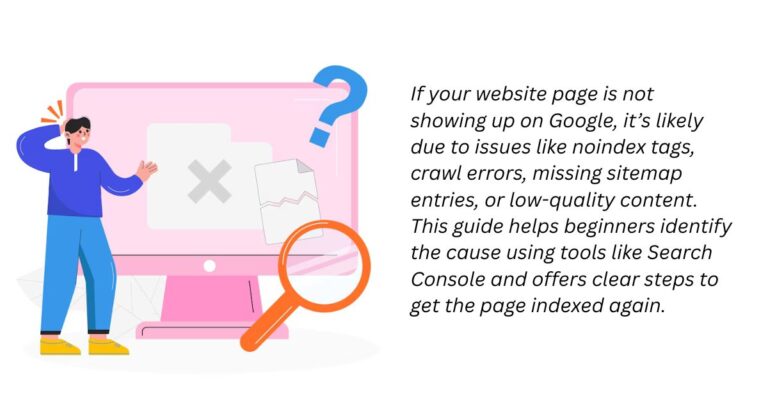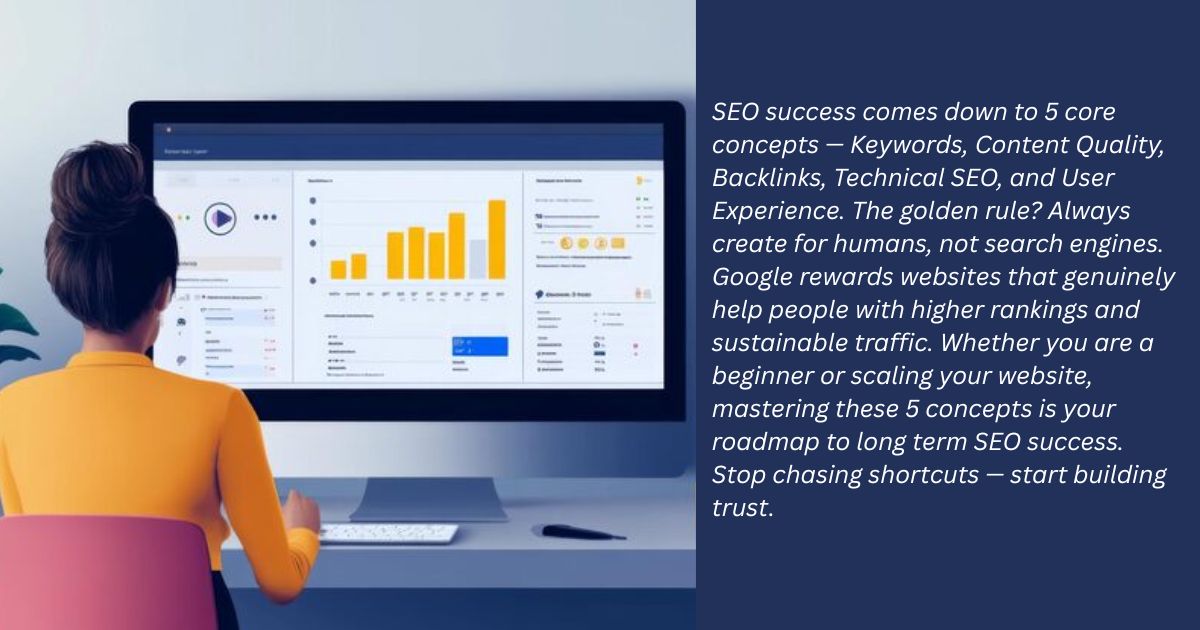

Let’s be real — if your website is not showing up on Google, it basically does not exist.
Over 68% of all online experiences begin with a search engine, and 75% of people never scroll past the first page of search results. That means if you are not ranking on page one, you are invisible to three out of four potential visitors.
This is exactly where SEO (Search Engine Optimization) comes in.
Think of Google as a giant library. When you search for something, Google’s job is to find the most relevant, trustworthy, and helpful book (website) for your question. SEO is the process of making sure YOUR website is the one Google picks off the shelf.
But here’s the problem — most people treat SEO like a mystery. They throw in a few keywords, hope for the best, and wonder why nothing moves.
The truth? SEO is not magic. It is a system. And like any system, once you understand its core concepts, you can make it work for you.
In this blog, I are going to break down the 5 most important concepts of SEO that will help you understand exactly what moves the needle and why. Whether you are a business owner, a blogger, or someone who just built their first website — by the end of this post, you will know what it actually takes to rank on Google and get the traffic your website deserves.
Search Intent & Keyword Research (The Demand Layer)
Before you write a single word on your website, you need to answer one critical question — what are people actually searching for?
This is what keyword research is all about. And sitting right at the heart of keyword research is something even more important — Search Intent.
What is Search Intent?
Search Intent is simply the reason behind a search. It is the “why” behind what someone types into Google.
Think of it this way — if a kid wants chocolate, they might say “I want chocolate.” But do they want to eat it? Buy it? Make it at home? The words are the same, but the intent is different.
Google is smart enough to figure out that difference. And if your content does not match what the user actually wants, Google will not show it — period.
There are 4 types of Search Intent you need to know:
- Informational: The user wants to learn something. (Example: “What is SEO?”)
- Navigational: The user wants to find a specific website. (Example: “Ahrefs login”)
- Commercial: The user is researching before buying. (Example: “Best SEO tools 2024”)
- Transactional: The user is ready to take action. (Example: “Buy SEO course online”)
If someone searches “how to lose weight” and you show them a product page to buy weight loss pills — that is an intent mismatch. Google will bury that page. Always match your content type to the intent behind the keyword.
What is Keyword Research?
Keyword research is the process of finding the exact words and phrases your target audience types into Google when they are looking for something related to your business, product, or content.
Here is a simple way to think about it — keywords are the bridge between what people are searching for and what you are offering. If you build the wrong bridge, nobody crosses it.
For example: If you run a bakery in Mumbai and you are targeting the keyword “bakery” — you are competing with millions of websites globally. But if you target “best birthday cake bakery in Mumbai” — you are speaking directly to someone who is nearby, specific, and ready to buy. That is the power of the right keyword.
The Numbers That Prove It Matters
The data does not lie:
90.63% of pages get zero traffic from Google — according to Ahrefs. The number one reason? They are targeting the wrong keywords or ignoring search intent entirely.
50% of search queries are four words or longer — meaning people search in specific phrases, not just single words. These are called long-tail keywords and they are easier to rank for and often convert better.
Keywords with clear commercial or transactional intent convert at nearly 3x the rate of informational keywords — because the user is already closer to making a decision.
Content Quality & Topical Authority (The Relevancy Layer)
Google processes 8.5 billion searches every single day. And for every one of those searches, its job is to find the most relevant, trustworthy answer. So the real question is — how does Google decide whose content deserves to show up first?
The answer comes down to two things: Content Quality and Topical Authority.
What is Content Quality?
Does your content actually answer the question? Google’s Helpful Content System, rolled out in 2022 and strengthened in 2023, is specifically designed to reward content written for people, not for search engines. Pages that exist just to rank — with no real value for the reader — are actively being pushed down in rankings.
Is it accurate and trustworthy? A 2023 study by Semrush found that long-form content (over 3,000 words) gets 3x more traffic and 4x more shares than average-length posts. But here’s the catch — that only holds true when the content is genuinely in-depth and accurate. Word count alone means nothing.
Is it original? Google’s systems are now sophisticated enough to detect whether your content adds something new to the conversation or is just rehashing what’s already out there. Thin, duplicate, or AI-spun content with no original insight is one of the fastest ways to lose rankings.
What is Topical Authority?
Now here’s where it gets really interesting — and this is the part most people miss.
Imagine you have a stomach ache. Would you rather get advice from a random person on the street, or from a doctor who has spent 10 years studying digestive health? Obviously the doctor, right? Google thinks the same way.
Topical Authority means Google sees your website as an expert on a specific subject. Not just one article — but a whole collection of deeply connected, well-researched content around a topic.
For example, if you run a blog about coffee and you have articles covering:
- How espresso machines work
- The difference between Arabica and Robusta beans
- How to brew the perfect pour-over
- The history of coffee in Ethiopia
- How caffeine affects the brain
…Google starts to recognize your site as a go-to source for everything coffee-related. That trust builds over time and directly impacts how well all your content ranks.
This is called a Topic Cluster model — one main “pillar” page covering a broad topic, supported by multiple “cluster” pages going deep on specific sub-topics. All of them linked together. HubSpot pioneered this model and reported a significant increase in organic traffic after restructuring their content this way.
Technical SEO (The Crawl & Experience Layer)
Think of your website like a library. You have thousands of amazing books (your content), but if the library is dark, the shelves are broken, and the librarian has no idea where anything is — nobody is going to find what they need. That is exactly what happens when your Technical SEO is broken. Google’s crawlers (called “Googlebots”) are like that librarian. If they can’t get in, can’t read your pages, or can’t move around your site easily — your content simply does not exist in Google’s eyes, no matter how good it is.
Technical SEO is the foundation that everything else sits on. Get this wrong, and your keyword research, your backlinks, your content — all of it becomes significantly less effective.
Crawling — Can Google Even Find You?
Before Google can rank your page, it needs to find it. Googlebot visits websites by following links, just like you would click from one page to another. If your pages are not linked internally, or if your robots.txt file (a small file that tells Google what it can and cannot access) is accidentally blocking important pages, Google simply skips them.
According to Google, sites with poor internal linking structures are among the most common causes of pages not being indexed. A study by Ahrefs found that 90.63% of pages get zero organic traffic from Google — and one of the biggest reasons is that they were never properly crawled or indexed in the first place.
What to check:
- Make sure your robots.txt isn’t blocking pages you want ranked
- Submit an XML sitemap to Google Search Console so Googlebot knows exactly where to go
- Fix orphan pages (pages with no internal links pointing to them)
Indexing — Can Google Understand and Store Your Page?
Crawling and indexing are two different things. Crawling is Google visiting your page. Indexing is Google deciding to store it in its database so it can show up in search results.
Pages can get crawled but NOT indexed. This happens when:
- Your page has a “noindex” tag mistakenly added to it
- Your content is too thin or duplicate
- Your page has canonical tag errors pointing Google to a different version of the page
Google’s index currently holds hundreds of billions of web pages. To get your slice of that, your pages need to be technically clean — no duplicate content, proper canonical tags, and no conflicting directives.
Page Speed — Every Second Costs You Money
This is where it gets very real. Google officially made page speed a ranking factor for mobile searches in 2018. But beyond rankings, slow speed destroys user behavior.
The numbers are brutal:
- A 1-second delay in page load time reduces conversions by 7% (Akamai)
- 53% of mobile users abandon a site if it takes longer than 3 seconds to load (Google)
- Pages that load in 1 second have a conversion rate 3x higher than pages that load in 5 seconds (Portent)
Google measures page speed through a framework called Core Web Vitals, which has three key metrics:
LCP (Largest Contentful Paint) — how long it takes for the biggest element on your page (usually an image or heading) to load. Google wants this under 2.5 seconds.
FID/INP (Interaction to Next Paint) — how quickly your page responds when a user clicks something. Should be under 200 milliseconds.
CLS (Cumulative Layout Shift) — measures how much your page “jumps around” while loading. Ever tried clicking a button and the page shifted and you clicked the wrong thing? That’s bad CLS. Google wants a score below 0.1.
Mobile-Friendliness — Google Looks at Your Mobile Site First
Here’s something most people don’t realize: Google uses the mobile version of your website as the primary version for ranking. This is called Mobile-First Indexing, and it has been fully rolled out since 2023.
If your desktop site looks great but your mobile site is a mess — you are being ranked on the mess.
Over 63% of all Google searches now come from mobile devices (Statista, 2024). If your website isn’t built responsively — meaning it doesn’t automatically adjust to fit smaller screens — you are losing rankings and you are losing users simultaneously.
HTTPS & Site Security — Trust Is a Ranking Signal
Google confirmed HTTPS as a ranking signal back in 2014. Today, if your website still runs on HTTP (without the padlock icon in the browser), Google flags it as “Not Secure.” That warning alone is enough to send users immediately back to the search results.
As of 2024, over 95% of pages loaded in Chrome are loaded over HTTPS (Google Transparency Report). If you’re in the remaining 5%, you are actively hurting your credibility and your rankings.
An SSL certificate (what converts your site from HTTP to HTTPS) is no longer optional — it is the bare minimum entry requirement to be taken seriously by both Google and your visitors.
Structured Data — Speaking Google’s Language
Structured data (also called Schema Markup) is a way of adding extra code to your page that tells Google exactly what your content is about in a language it understands perfectly.
For example, if you have a recipe page, structured data can tell Google: “This is a recipe. It takes 30 minutes. It has 4 stars from 200 reviews.” Google can then display that information directly in search results as a Rich Snippet — making your result stand out visually from every other blue link on the page.
Pages with rich snippets have been shown to achieve 20-30% higher click-through rates than standard results (Search Engine Land). You rank in the same position but get significantly more clicks — simply because your result looks better.
Backlinks & Authority (The Trust Layer)
Imagine you are new in school. Nobody knows you. But then the most popular kid in school walks up and says “Hey, this person is really smart, you should listen to them.” Suddenly, everyone trusts you.
That is exactly how backlinks work on the internet.
A backlink is when another website links to your website. Google sees that link as a vote of confidence. It basically means that website is saying “Hey, this content is good enough for me to send my readers there.” The more of these votes you collect, the more Google trusts you.
But Not All Votes Are Equal
Here is where most people get it wrong. 100 backlinks from random, low-quality websites are worth far less than 5 backlinks from highly trusted, authoritative websites.
Think of it this way. Would you rather have 100 strangers vouch for you, or have Forbes, The New York Times, or Harvard vouch for you? The answer is obvious.
Google measures this trust through a concept called Domain Authority (DA) — a score from 1 to 100 that predicts how well a website can rank on search engines. Websites like Wikipedia sit near 90+. A brand new blog starts near zero.
What Makes a Backlink “Good”?
Not every link pointing to your site helps you. Some can actually hurt you. Here is what separates a good backlink from a bad one:
Relevance — A backlink from a fitness blog to your gym equipment store makes sense. A backlink from a gambling site to your recipe blog makes zero sense, and Google knows it.
Authority of the linking site — A link from a well-established, trusted website carries far more weight than a link from a website that was created last week.
Anchor Text — This is the clickable text of the link. If someone links to you using the words “best running shoes,” Google understands that your page is about running shoes. It adds context.
Do-Follow vs No-Follow — A do-follow link passes authority to your site. A no-follow link tells Google not to count it as a vote. You want do-follow links as much as possible.
How Do You Actually Build Backlinks?
This is the part everyone wants to know. There are no real shortcuts here — the strategies that work require effort:
Guest Posting — You write a high-quality article for another website in your niche and in return they link back to you. This is one of the most effective and widely used methods.
The Skyscraper Technique — Find content in your niche that already has a lot of backlinks. Create something significantly better. Then reach out to the websites linking to the original piece and show them your superior version. Backlinko’s Brian Dean used this technique to increase his organic traffic by 110% in just 14 days.
Digital PR — Get your brand, data, or stories picked up by journalists and publications. A single mention in a major publication can send powerful authority signals to Google.
Broken Link Building — Find broken links on other websites (links that lead to a 404 error), then reach out to the site owner and suggest your content as a replacement. You are helping them fix a problem while earning yourself a backlink.
User Experience & Behavioral Signals (The Engagement Layer)
Google is not just reading your website. It is watching how people behave on it.
Think of it this way. Imagine you open a shop. A hundred people walk in, but 90 of them turn around and leave within 10 seconds. That tells you something is seriously wrong, right? Google thinks the exact same way about your website.
This is what User Experience (UX) and Behavioral Signals are all about. They are the invisible scorecard Google keeps on how real users interact with your site.
What Are Behavioral Signals?
Behavioral signals are the actions users take (or don’t take) on your website. Google tracks these signals to decide whether your page deserves to rank higher or get pushed down.
The big ones you need to know:
- Bounce Rate This is the percentage of people who land on your page and leave without clicking anything else. A high bounce rate is a red flag. According to Semrush, the average bounce rate across industries is around 41–55%. If yours is above 70%, your page is likely failing to deliver what users came for.
- Dwell Time This is how long someone stays on your page before going back to Google. If someone clicks your link, reads for 4 minutes, and then leaves satisfied — that is a strong positive signal. If they bounce back in 8 seconds — that tells Google your content did not answer their question.
- Click-Through Rate (CTR) Out of everyone who sees your page in Google search results, how many actually click on it? A study by Backlinko found that the #1 result on Google gets an average CTR of 27.6% — nearly 10x more than the #10 result. A low CTR tells Google your title and meta description are not compelling enough.
- Pages Per Session Are users exploring more of your site after landing on one page? Or are they stuck on one page and leaving? The more pages they visit, the more Google sees your site as valuable and worth recommending.
Why Google Cares About This
Google’s entire business model depends on one thing — giving people the best possible answer to their search. If Google keeps sending people to your page and those people keep leaving unhappy, Google loses trust. And Google does not tolerate that for long.
In fact, Google’s own Search Quality Evaluator Guidelines mention the concept of “Page Quality” which heavily ties into whether a page satisfies user intent. If users are satisfied, you rank. If they are not, you drop.
Mobile Experience Is Non-Negotiable
Over 60% of all Google searches now happen on mobile devices. Google switched to Mobile-First Indexing back in 2019 — meaning Google primarily looks at the mobile version of your site to decide your rankings, not the desktop version.
If your website looks broken, loads slowly, or is hard to navigate on a phone — you are not just losing users. You are actively being penalized in rankings.
Every time a user visits your site, they are casting a vote. A long visit, a deeper click, a return visit — these are positive votes. A quick exit back to Google is a negative vote.
Google collects millions of these votes every single day and uses them to constantly re-rank websites. You can have the most perfectly optimized page on paper, but if real users do not enjoy being on it — Google will find someone else to show instead.
UX is not a design problem. It is an SEO problem. Treat it like one.
How These 5 Concepts Work Together
Here’s the content for that section:
How These 5 Concepts Work Together
SEO is not a one-trick game. You cannot just do keyword research and call it a day. You cannot just build backlinks and expect to rank on page one. All 5 concepts — keyword research, on-page SEO, technical SEO, link building, and content quality — work as a system. Remove one, and the whole thing weakens.
Think of it like a car. The engine is your content — it powers everything. The fuel is your keywords — without them, the engine has no direction. The roads are your backlinks — they determine how far and fast you can go. The car’s chassis and mechanics are your technical SEO — if something is broken under the hood, the car won’t move no matter how good the engine is. And on-page SEO? That’s your steering wheel — it tells Google exactly where you want to go.
Here’s what the data says about working in silos:
A study by Ahrefs found that 90.63% of pages get zero organic traffic from Google. The #1 reason? They don’t have a complete SEO strategy. They focus on one or two concepts and ignore the rest.
Let’s break down exactly how these concepts feed into each other:
Keywords inform everything else. When you identify the right keywords, your content knows what to say, your on-page SEO knows what to optimize, and your link building knows what anchor text to use. Without keyword research, you’re essentially writing in the dark and hoping Google finds you.
Content brings keywords to life. Keywords alone are just words in a spreadsheet. Content is where those keywords get meaning. Google’s own research confirms that content relevance and depth are among the top ranking factors. A page that thoroughly answers a user’s question will always outperform a page that just stuffs keywords into thin paragraphs.
On-page SEO makes sure Google understands your content. You could write the most brilliant piece of content in the world, but if your title tag is missing, your headings are a mess, and your meta description is blank — Google struggles to categorize it. On-page SEO is essentially you speaking Google’s language so it can place your content in front of the right people.
Technical SEO makes sure Google can even find your content. Here’s a scary fact — if your site takes more than 3 seconds to load, 53% of mobile users will abandon it (Google, 2018). If Google’s crawler hits a wall of broken links, slow pages, or poor mobile experience, your content never even gets a fair shot at ranking — no matter how good it is.
Backlinks act as votes of confidence for everything above. Once your content is solid, your on-page is tight, and your technical foundation is clean — backlinks amplify it all. According to Backlinko, the #1 result on Google has an average of 3.8x more backlinks than results in positions 2 through 10. Backlinks tell Google: “Other people trust this page.” And Google listens.
The compounding effect is real. When all 5 concepts align, your SEO results don’t just add up — they multiply. A well-researched keyword, placed inside high-quality content, optimized on-page, sitting on a technically sound website, and backed by strong backlinks — that is a page built to rank, hold its position, and drive consistent traffic month after month.
The brands dominating Google search today — HubSpot, NerdWallet, Healthline — are not winning because of one SEO trick. They are winning because they treat SEO as an integrated system, not a checklist of isolated tasks.
The bottom line is simple: master each concept, then connect them. That’s where rankings live.
What is the 80/20 rule in SEO?
You don’t need to do everything to win at SEO. You just need to do the right things.
That’s exactly what the 80/20 rule in SEO tells you. Also known as the Pareto Principle, it states that 80% of your results come from just 20% of your efforts. This rule was originally observed by Italian economist Vilfredo Pareto, who noticed that 80% of Italy’s land was owned by just 20% of the population. Over time, this pattern showed up everywhere — including SEO.
How Does This Apply to SEO?
Studies show that the top 3 results on Google capture over 54% of all clicks. The first result alone gets around 27.6% of all clicks (Source: Backlinko, 2023). That means if you rank on page 2, you’re practically invisible — less than 1% of users ever go there.
This is the 80/20 rule in action. A small number of pages, keywords, and backlinks drive the overwhelming majority of your organic traffic.
Here’s what that looks like in practice:
A small number of keywords drive most of your traffic. If you audit almost any website on Google Search Console, you’ll find that roughly 20% of your keywords are responsible for 80% of your impressions and clicks. Most of your keyword list is just noise.
A small number of pages drive most of your conversions. You might have 200 blog posts on your website, but chances are, 10 to 20 of them are doing the heavy lifting — bringing in leads, signups, and sales.
A small number of backlinks carry most of your domain authority. Not all links are equal. One backlink from a high-authority site like Forbes or HubSpot can outweigh 500 links from low-quality directories.
What is the Golden Rule of SEO?
If there is one rule that every SEO expert lives by, it is this — create content for humans, not search engines.
Google has said it publicly, repeatedly, and without apology. Their entire algorithm is built around one goal: to show users the most helpful, relevant, and trustworthy content possible. And yet, millions of websites still try to “trick” Google into ranking them higher by stuffing keywords, buying fake links, and publishing content that sounds robotic.
It does not work. And here is the data to prove it.
According to Google’s own Search Quality Evaluator Guidelines, pages are rated on a concept called E-E-A-T — Experience, Expertise, Authoritativeness, and Trustworthiness. Pages that score low on these signals struggle to rank, no matter how many keywords they cram in.
Think of it like this — imagine you walk into a store and ask an employee for help. One employee gives you a clear, honest answer that actually solves your problem. Another employee just keeps repeating the name of the product over and over without explaining anything. Who are you going to trust? Obviously the first one. Google thinks exactly the same way.
Here is what the golden rule looks like in practice:
When someone types a question into Google, they have an intention behind it — they want to learn something, buy something, or find something. SEO calls this search intent. The golden rule means your content must match that intent perfectly. Not partially. Not almost. Perfectly.
A study by Backlinko analyzing over 11 million Google search results found that the top-ranking pages are not always the ones with the most backlinks or the longest content — they are the ones that best satisfy what the user was looking for.
So the golden rule of SEO can be broken down into three simple commitments:
- Answer the question fully. Do not make the reader go back to Google to find more information. If they leave your page unsatisfied, Google notices that and pushes your page down.
- Be easy to understand. Google’s algorithm measures how long people stay on your page and how they interact with it. If your content is confusing or hard to read, people leave fast — and that is a signal to Google that your page is not good enough.
- Be honest and trustworthy. Do not make false claims, exaggerate results, or mislead your audience. Google actively penalizes content that is misleading or low quality, especially after its 2022 Helpful Content Update, which wiped out traffic for thousands of websites that were publishing content purely to rank rather than to help.
The bottom line is simple — if your content genuinely helps someone, Google will reward you. If it does not, no amount of technical SEO tricks will save you. That is the golden rule, and it has never changed since Google’s very first day.
Final Words
SEO can feel overwhelming when you are just starting out. There are hundreds of ranking factors, algorithm updates happening every few months, and a sea of conflicting advice on the internet. But here is the truth — if you understand the core concepts and stick to them consistently, SEO is not complicated. It is just patient work.
The 5 important concepts we covered in this blog are not theories. They are the foundation that every successful website on the internet is built on. Google processes over 8.5 billion searches every single day according to Internet Live Stats. That is 8.5 billion opportunities for your content to show up and help someone. But only if you play by the right rules.
So here is what you should take away from this blog:
Stop chasing shortcuts. The websites that try to game the algorithm are the same websites that disappear overnight after every Google update. The websites that focus on genuinely helping people are the ones that grow steadily and survive every update Google throws at them.
Start small, stay consistent. You do not need to fix everything at once. Pick one concept, apply it, and move to the next. SEO is a marathon, not a sprint. Even the biggest websites in the world started with zero traffic.
And most importantly — always come back to the golden rule. If the content you are creating truly helps the person reading it, you are already ahead of the majority of websites out there.
SEO rewards those who are willing to put in the work without expecting overnight results. Be that person, and the results will come.
Frequently Asked Questions
Is SEO free or does it cost money?
SEO itself is free in the sense that you do not pay Google to rank your website. However, it does cost time, effort, and sometimes money if you hire an SEO expert, use paid tools like Ahrefs or SEMrush, or invest in content creation. Think of it as a long term investment rather than a one time expense.
How often does Google update its algorithm?
Google makes thousands of small updates every year and several major updates that can significantly impact rankings. On average, Google confirms around 8 to 12 major algorithm updates per year. This is why staying consistent with good quality content always beats trying to game the system.
What is the difference between on-page and off-page SEO?
On-page SEO refers to everything you do on your own website — optimizing your content, headings, images, page speed, and keywords. Off-page SEO refers to activities outside your website, mainly building backlinks from other trusted websites. Both are equally important for ranking well.
Do keywords still matter in 2024?
Yes, keywords still matter but the way you use them has changed. Stuffing keywords into your content no longer works and can actually hurt your rankings. Today, Google focuses more on the overall topic and search intent behind the keyword rather than how many times the keyword appears on the page.
What is a backlink and why is it important?
A backlink is when another website links to your website. Think of it as a vote of confidence. The more high quality websites that link to you, the more Google trusts your website. According to Backlinko, the number one result on Google has an average of 3.8 times more backlinks than the pages ranking in positions 2 through 10.
Can I do SEO on my own or do I need an expert?
Absolutely, you can do SEO on your own, especially if you are just starting out. There are plenty of free resources, tools, and guides available. However, as your website grows and competition increases, hiring an SEO expert can help you scale faster and avoid costly mistakes.
What is the difference between SEO and paid ads?
SEO brings you organic traffic, meaning people find you naturally through search without you paying for every click. Paid ads like Google Ads put you at the top instantly but the moment you stop paying, the traffic stops. SEO takes longer but the results are more sustainable and cost effective in the long run.
Does social media affect SEO?
Social media does not directly impact your Google rankings. However, it indirectly helps SEO by driving more traffic to your website, increasing brand awareness, and getting your content in front of people who may link back to it. More visibility often leads to more backlinks, which does help your SEO.
What is the biggest SEO mistake beginners make?
The biggest mistake beginners make is focusing too much on rankings and not enough on the reader. They write content for search engines instead of for people, ignore search intent, and expect results too quickly. SEO is about building trust — with your audience and with Google. Start with helping people genuinely, and the rankings will follow.
Explore for more such info – https://thejatinagarwal.in/